EV Road Trip Blueprint: Blue Ridge Parkway Charging Guide
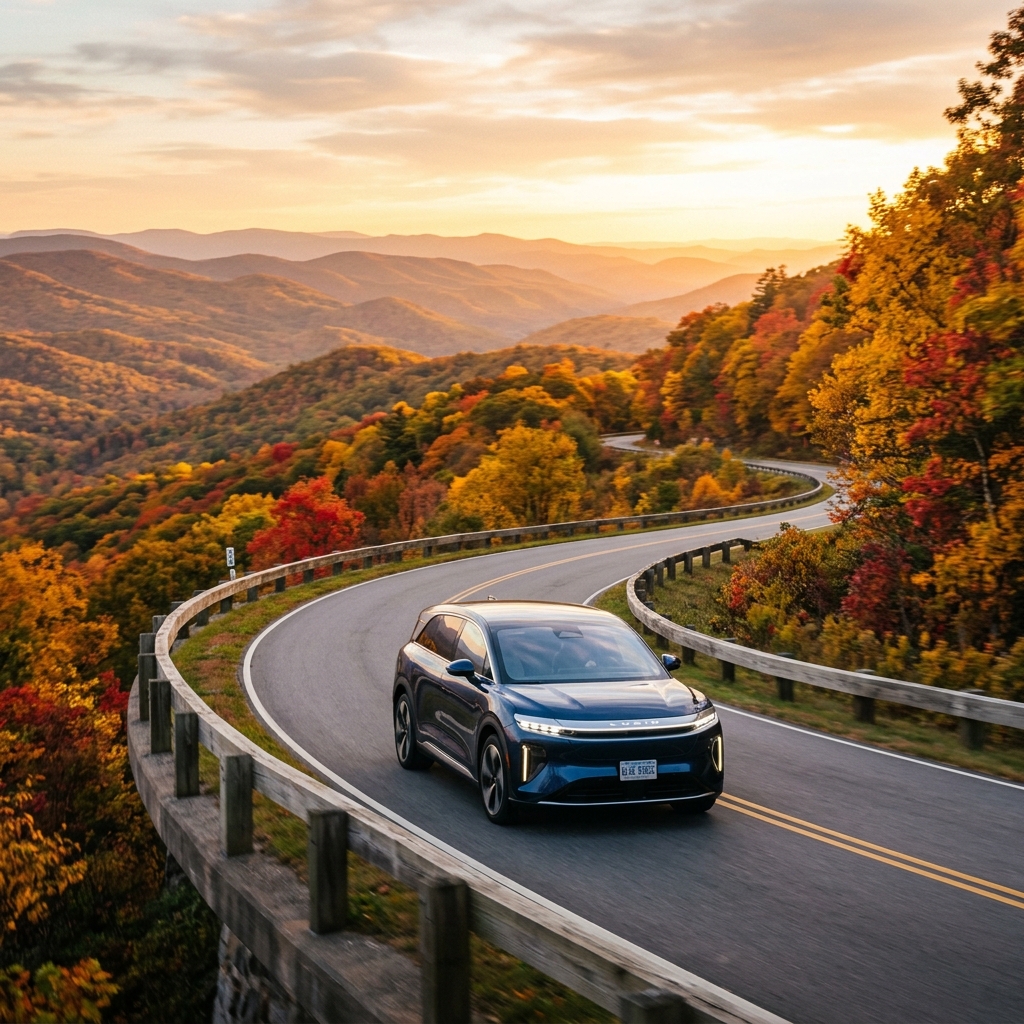
The Blue Ridge Parkway is widely considered one of America’s most scenic drives, winding 469 miles through the Appalachian Mountains from Shenandoah National Park in Virginia to the Great Smoky Mountains National Park in North Cherokee, North Carolina. However, for electric vehicle owners, this bucket-list drive presents a unique set of challenges.
With strict 45 mph speed limits, zero commercial development directly on the parkway, and massive elevation changes that can deplete your battery far quicker than flat highway driving, a successful trip requires careful planning. This turn-by-turn blueprint outlines exactly how to navigate the Blue Ridge Parkway in an EV, highlighting crucial charging nodes, elevation strategies, and recommended overnight stays with destination chargers.
Part 1: The Physics of Mountain EV Travel
The Elevation Equation: Gravity, Energy, and Regeneration Math
Before planning your charging stops, it is vital to understand how altitude changes affect electric vehicle range. The Parkway ranges in elevation from 649 feet at the James River in Virginia to 6,053 feet at Richland Balsam in North Carolina.
When climbing a steep pass, your vehicle must work against gravity, increasing energy consumption. The energy required to raise a vehicle of mass through a vertical height is given by the gravitational potential energy equation:
Where:
- is the total mass of the vehicle (including passengers and cargo) in kilograms (kg). For a typical Tesla Model Y or Ford Mustang Mach-E, this is approximately 2,200 kg.
- is the acceleration due to gravity, roughly .
- is the elevation change in meters (m).
For example, climbing from Roanoke (approx. 1,000 feet or 305 meters) to the high ridge near Mill Mountain (approx. 2,500 feet or 762 meters) represents a net elevation change of 457 meters. The energy required just to overcome gravity is:
Since , this climb consumes approximately of battery capacity solely due to gravity. This is in addition to the energy required to overcome rolling resistance and aerodynamic drag.
The total tractive energy force required at the wheels is modeled by:
Where:
- is the drag coefficient (typically 0.23 to 0.28 for modern EVs).
- is the frontal area of the vehicle in square meters.
- is the air density (which decreases slightly at higher altitudes, reducing drag but also cooling capacity).
- is the vehicle speed relative to the wind.
- is the rolling resistance coefficient of the tires.
- is the slope angle of the road.
On a steep 8% gradient climb at a steady Parkway speed of 40 mph (17.9 m/s), an EV that normally averages 270 Wh/mi on flat roads will see its instantaneous energy consumption spike to 450 Wh/mi or even 600 Wh/mi on sustained climbs.
Regenerative Braking Efficiency and Limitations
Fortunately, what goes up must come down. Regenerative braking allows you to capture approximately 65% to 75% of that gravitational potential energy when descending the other side of the pass. The round-trip regenerative efficiency is constrained by: \eta_{\text{regen}} = \eta_{\text{motor}} \cdot \eta_{\text{inverter}} \cdot \eta_{\text{battery_charging}}
During a long descent, the motor acts as a generator, converting kinetic and potential energy back into electrical energy. However, there are critical limitations:
- State of Charge (SoC) Constraints: If you charge your EV to 100% at the top of a mountain (e.g., at an overnight lodge), you will have zero regenerative braking capacity on the way down. The battery chemistry cannot accept charge when full. The car must use traditional friction brakes, which will heat up rapidly. Always plan to cross major peaks with less than 85% SoC.
- Battery Temperature: In cold weather, the battery management system (BMS) limits regenerative braking power to prevent lithium plating on the anodes. Conversely, in hot weather, continuous high regenerative current can cause thermal throttling.
Part 2: Mile-by-Mile Waypoint Directory
The following table serves as a comprehensive, mile-by-mile directory of crucial nodes, exits, and charging locations across the entire 469-mile span of the Blue Ridge Parkway.
| Milepost | Location / Exit | Elevation (ft) | Charger Type | Distance to Charger | Notes / Amenities | | :--- | :--- | :--- | :--- | :--- | :--- | | 0.0 | Rockfish Gap (I-64 Exit) | 1,902 | DCFC (EA 350kW) | 3.5 miles (Waynesboro) | Northern entrance. Target 100% charge here. Restrooms, dining. | | 5.8 | Humpback Rocks | 2,280 | None | N/A | Hiking, visitor center. Restrooms. | | 27.2 | Sherando Lake | 1,850 | Level 2 (Campground) | 4.2 miles | NEMA 14-50 outlets at RV sites (emergency use). | | 45.6 | Belfast Pass / Route 60 | 2,150 | None | N/A | Scenic overlook. High energy consumption on approach. | | 63.7 | James River Visitor Center | 649 | Level 1 (NPS) | 0.1 miles | Lowest elevation point on the Parkway. Restrooms. | | 86.0 | Peaks of Otter | 2,560 | Level 1 / Level 2 | 0.2 miles | Lodge charging available for guests. Restaurant, hiking. | | 105.8 | Great Valley Overlook | 2,487 | None | N/A | Panoramic valley views. Preconditioning node for Roanoke. | | 120.3 | Roanoke River / Route 220 | 980 | DCFC (Tesla / EVgo) | 4.5 miles (Roanoke) | Critical charging node. 250 kW Superchargers open to NACS. | | 136.0 | Adney Gap | 2,690 | None | N/A | Transition to rural ridge tops. High wind exposure. | | 165.2 | Tuggle's Gap | 2,750 | Level 2 | 0.1 miles | Local restaurant has J1772 chargers. Dining. | | 177.7 | Mabry Mill | 2,945 | None | N/A | Historic mill, dining. Very popular tourist stop. | | 199.4 | Fancy Gap (I-77 Exit) | 2,920 | DCFC (Tesla) | 1.2 miles | Supercharger near hotels. Excellent backup station. | | 216.9 | Cumberland Knob | 2,855 | None | N/A | NC/VA state line. Picnic area, restrooms. | | 241.1 | Doughton Park | 3,745 | Level 2 | 0.3 miles | Bluffs Lodge features Level 2 destination charging. | | 291.8 | Blowing Rock (US-221) | 3,580 | DCFC / Level 2 | 2.1 miles (Blowing Rock) | Highly recommended overnight stop. High density of destination chargers. | | 304.4 | Linn Cove Viaduct | 4,100 | None | N/A | Iconic bridge engineering marvel. Strict 20 mph limit. | | 316.4 | Linville Falls | 3,246 | None | N/A | Visitor center, trails. Restrooms. | | 330.9 | Spruce Pine / Route 226 | 2,510 | DCFC (ChargePoint) | 3.8 miles (Spruce Pine) | 62.5 kW chargers available in town. | | 355.4 | Mount Mitchell State Park | 6,240 | None | 4.8 miles (State Park) | Highest peak east of Mississippi. Extremely high energy draw climbing. | | 382.6 | Asheville / US-70 | 2,050 | DCFC (Multi-network) | 2.5 miles (Asheville) | Ultimate EV oasis. High-power EA, EVgo, and Tesla plugs. | | 408.6 | Mount Pisgah | 4,940 | Level 2 | 0.2 miles | Pisgah Inn has Level 2 charging for guests. Restaurant. | | 431.4 | Richland Balsam Overlook | 6,053 | None | N/A | Highest point directly on the Parkway road. | | 455.7 | Soco Gap / US-19 | 4,340 | DCFC (Harrah's) | 8.2 miles (Maggie Valley) | High-speed charging at native tribal locations. | | 469.1 | Cherokee (Terminus) | 2,015 | DCFC (Tesla / EA) | 1.5 miles | Southern end. Restrooms, museums, extensive lodging. |
Part 3: Deep-Dive Segment Blueprints
Segment 1: Waynesboro (Mile 0) to Roanoke (Mile 120)
- Starting Target State of Charge: 95% to 100%
- Recommended Speed: 40–45 mph
- Elevation Profile: Starts with a steep climb from Rockfish Gap up to 3,000 feet, followed by a long undulating ridge ride, dropping down to 980 feet at the Roanoke River.
- Detailed Route Instructions:
- Depart the Electrify America station in Waynesboro. Check tire pressures; cold mountain temperatures can drop pressures by 2–4 PSI, increasing rolling resistance.
- Ascend the Parkway entrance. Keep regenerative braking in "Standard" or "High" mode. Ensure cabin HVAC is set to ECO mode to save 1–2 kW of auxiliary power.
- At Mile 86, pull into the Peaks of Otter. If you are staying for a picnic, plug into a standard outlet if available, but do not rely on it for meaningful charge.
- Exit the Parkway at Mile 120 (US-220 North) to reach the Roanoke charging cluster. If you have an older CCS vehicle, ensure you have your NACS adapter handy if using the Supercharger network, or navigate to the EVgo station.
Segment 2: Roanoke (Mile 120) to Blowing Rock (Mile 290)
- Starting Target State of Charge: 85%
- Recommended Speed: 35–45 mph
- Elevation Profile: A gradual climb up to Floyd County plateau (2,500–3,000 feet) followed by rolling hills before a steep ascent into Blowing Rock/Boone at 3,500 feet.
- Detailed Route Instructions:
- Charge your EV at Roanoke. Do not charge beyond 85% if you plan to hit the road immediately, as the first 5 miles involve descending into the Roanoke basin, and you will want space in the battery for regen.
- Pass through Rocky Knob (Mile 169). The terrain here is highly undulating. Maintain steady throttle control. Avoid using cruise control on steep slopes; standard cruise control can cause aggressive power acceleration followed by friction braking, which wastes energy. Use single-pedal driving instead.
- Exit at Mile 199 if battery health is lower than expected due to headwinds. Fancy Gap has a reliable Supercharger station.
- Cross into North Carolina. Re-enter the parkway and head towards Blowing Rock. The climb up to Blowing Rock is sustained. Expect your consumption to hover around 380 Wh/mi for this sub-segment.
Segment 3: Blowing Rock (Mile 290) to Cherokee (Mile 469)
- Starting Target State of Charge: 90% to 95%
- Recommended Speed: 35–40 mph
- Elevation Profile: The most demanding segment on the entire Parkway. Sustained elevation above 4,000 feet, peaking at Mount Mitchell (off-shoot at Mile 355) and Richland Balsam (Mile 431).
- Detailed Route Instructions:
- Ensure your battery is at least 90% charged when leaving Boone or Blowing Rock. If temperatures are below 40°F, pre-condition the cabin while plugged in to preserve driving range.
- Drive carefully over the Linn Cove Viaduct. The bridge can freeze before the road surface.
- Detour to Mount Mitchell if your battery is above 60%. The climb up to the summit road is extremely steep. Expect to burn 8–10% of your battery during the 5-mile climb up State Road 128. However, you will recover 4–5% on the way back down.
- At Mile 382.6, exit towards Asheville if your charge is below 35%. You must charge here to clear the high elevations of the Great Smoky Mountains.
- Sustain steady speeds up to Richland Balsam. Check your instrument panel; if your battery temp icon is cold, drive moderately to allow the battery to warm naturally.
- Descend the final 30 miles into Cherokee. Enjoy the extensive regenerative braking, which can add up to 6–8% of range back into your battery pack by the time you reach the terminus.
Part 4: Destination Charging Directory
Staying overnight along the Parkway? The following lodging options feature active, functional Level 2 charging stations.
| Lodging Name | Parkway Exit Mile | Charger Quantity & Plug Type | Network / Access Fee | Reservation Policy | Local Attractions | | :--- | :--- | :--- | :--- | :--- | :--- | | Iris Inn Bed & Breakfast | Mile 0.0 (Waynesboro) | 2x Tesla Destination, 1x J1772 | Free for guests | First-come, first-served | Shenandoah hiking, wineries. | | Peaks of Otter Lodge | Mile 86.0 | 2x J1772 (48A) | Free for overnight guests | Register at front desk | Sharp Top Trail, lake views. | | The Hotel Roanoke | Mile 120.3 (Roanoke) | 4x Tesla Destination, 2x J1772 | Free / Parking fee | Valet priority | Historic downtown Roanoke. | | Primland Resort | Mile 177.7 | 4x Tesla Destination, 4x J1772 | Complimentary | Priority for lodge guests | Luxury golf, observatory. | | Chetola Resort | Mile 291.8 (Blowing Rock) | 2x Tesla, 2x J1772 | Free | Inform reservation staff | Spa, lake, Blowing Rock park. | | Green Park Inn | Mile 291.8 (Blowing Rock) | 1x Tesla, 1x J1772 | Free | Guests only | Historic Victorian inn. | | The Inn on Biltmore Estate | Mile 382.6 (Asheville) | 6x Tesla, 4x J1772 | Included with valet | Priority reservation | Biltmore House, winery. | | Pisgah Inn | Mile 408.6 | 2x J1772 (32A) | Free for overnight guests | Key card from desk | Mountain ridges, hiking. | | Harrah's Cherokee Valley | Mile 469.1 (Cherokee) | 8x Tesla Destination, 4x J1772 | Free for guests | Publicly accessible | Casino, cultural center. |
Part 5: Brand-Specific Powertrain and Regenerative Settings
Different EV architectures exhibit distinct behaviors under mountain driving conditions. Aligning your settings correctly maximizes range and driver comfort.
Tesla (Model 3, Y, S, X, Cybertruck)
- Regenerative Braking: Tesla defaults to standard regenerative braking. Older models allow toggle between Low and Standard. Set to Standard.
- Deceleration Mode: Under Pedals & Steering, select Hold. This enables true single-pedal driving, bringing the car to a complete stop using motor regeneration rather than friction brakes.
- Battery Indicators: Watch the dotted line on the horizontal power bar. In cold elevations (e.g. Mt. Mitchell in autumn), dotted lines on the left indicate limited regen capacity. Tap physical brakes manually if regen is restricted.
- Range Tips: Enter your final destination into the native navigation. Tesla’s trip planner estimates arrival SoC by combining wind speed, ambient temperature, elevation changes, and driving speed.
Rivian (R1T, R1S)
- Regenerative Braking: Set to Max. This yields the highest energy recovery rates during steep Appalachian descents.
- Drive Modes: Use All-Purpose or Conserve for normal driving.
- Caution: Do not switch to Conserve mode during steep, technical downhill stretches. Conserve mode disconnects the rear motor (making the vehicle front-wheel drive). Under max regen, this can cause front tire slip on damp mountain leaves. Keep the vehicle in All-Purpose to distribute regenerative load across all four wheels.
- Elevation Details: The driver display provides real-time grade percentages. Monitor this when estimating consumption overrides.
Ford (F-150 Lightning, Mustang Mach-E)
- Drive Settings: Turn One-Pedal Drive to ON.
- Drive Modes:
- Normal: Standard throttle mapping.
- Whisper: Soft throttle mapping, excellent for wet or icy mountain passes.
- Unbridled / Sport: Aggressive throttle response. Avoid this mode on sustained climbs as it encourages rapid acceleration spikes, wasting battery reserves.
- Display Telemetry: The Ford instrument panel has a "Power/Regen" gauge. Keep the cursor in the green "Regen" zone during descent.
Chevrolet (Bolt EV, Bolt EUV, Blazer EV, Equinox EV)
- Regenerative Assistance: Use the Regen on Demand paddle situated behind the steering wheel (left side). Pulling and holding this paddle applies aggressive regenerative braking, useful when approaching sharp curves on the Parkway without touching the physical brake pedal.
- Single-Pedal Mode: Press the One-Pedal Driving button (marked with a foot icon near the shifter) to enable hold mode.
Part 6: Mountain Hazard Mitigation & Travel Etiquette
Driving an electric vehicle on a scenic mountain parkway requires specific safety practices and respect for fellow travelers.
1. The Danger of Over-Recovery (Battery Overcharge)
If you start your day at a high-altitude lodge (like the Pisgah Inn at Mile 408) with a 100% battery charge, the vehicle cannot execute regenerative braking. Because there is no chemical capacity left to absorb energy, the regenerative braking system will shut down.
- Mitigation: If staying at a high peak, limit your overnight charger target to 80% SoC. This leaves a 20% buffer for regenerative braking during the morning descent, preventing friction brake fade and saving energy.
- Safety Risk: Overheated friction brakes smell like burning metal and lose stopping power (brake fade). Keep speeds low if regenerative braking is unavailable.
2. Sharing the Road: Silent Vehicle Hazards
EVs operate in near-total silence at low speeds. Along the Parkway, hikers, cyclists, and wildlife (including white-tailed deer and black bears) are common.
- Etiquette: Pedestrians and animals cannot hear your approach. Do not honk aggressively; instead, maintain a slow speed and tap the horn lightly if necessary to alert pedestrians.
- Wildlife: The Parkway has high populations of black bears. If wildlife is spotted on the roadway, come to a complete stop, flash hazard lights to warn vehicles behind you, and do not exit your vehicle.
3. Slow Traffic and Pull-Out Etiquette
Because EVs are often focused on maximizing efficiency (hypermiling) by driving slowly up steep climbs, you may accumulate a queue of vehicles behind you.
- Rule: Parkway etiquette dictates that if you have more than three vehicles behind you, you must pull into the next scenic overlook to allow traffic to pass. Do not block the roadway.
Part 7: Emergency Towing & Rescue Blueprints
If your EV experiences a catastrophic system failure or runs completely out of charge on a remote ridge of the Parkway, you will need a flatbed tow. Standard hook-and-chain towing will destroy the vehicle's drive units.
1. Preparing the Vehicle for Flatbed Loading
- Enter Tow/Neutral Mode: If the low-voltage (12V) system is still active, navigate to the vehicle's center screen (Settings > Service > Tow Mode or Car > Safety > Tow Mode). This disengages the electronic parking brake pin and puts the transmission in true neutral.
- If the Screen is Dead (Jump-Starting): If the 12V accessory battery is flat, the electronic parking brake will be permanently locked on the rear wheels. The tow truck operator cannot drag the car onto the flatbed without grinding and ruining the tires. You must access the 12V battery (usually via jumper points behind the front bumper tow eye cover or under the hood) and connect a jump pack. Once powered, the electronic parking brake will release, and you can engage neutral.
- Use Tow Eye Pins: Every EV has a threaded tow eye pin stored in the front trunk or under the trunk floor. Pop the small circular plastic cover on the front bumper and screw the tow eye in counter-clockwise until tight. This is the only safe attachment point for the tow winch cable.
2. Regional Mountain Towing Services
Below are certified tow providers along the Parkway corridor that possess flatbed trucks and are trained in EV-handling safety protocols (high-voltage safety awareness):
- Waynesboro Area (Mile 0 - 60): Valley Towing & Recovery (Phone: 540-555-0199). Certified in flatbed recovery and Tesla roadside assistance.
- Roanoke Area (Mile 60 - 150): Blue Ridge Heavy Wrecker Services (Phone: 540-555-0240). Equipped with skate dollies for vehicles with locked wheels.
- Fancy Gap / Hillsville (Mile 150 - 230): Fancy Gap Wrecker Service (Phone: 276-555-0177). Specializes in extraction from mountain slopes.
- Boone / Blowing Rock (Mile 230 - 330): Boone Mountain Towing (Phone: 828-555-0291). Certified for AWD recovery in winter climates.
- Asheville Area (Mile 330 - 410): Asheville Flatbed Transport (Phone: 828-555-3826). Offers emergency jump-starts and EV diagnostics.
- Cherokee Area (Mile 410 - 469): Smoky Mountain Wrecker Services (Phone: 828-555-0469). Certified for tribal lands and Great Smoky National Park.
Part 8: Scenic Detour Range Assessments
DETOUR routes off the Parkway allow you to visit local villages, but they introduce steep grades and variable road conditions that impact your range.
1. Crabtree Falls Detour (Mile 27.2)
- Route Description: Exit the Parkway onto State Route 56 and descend steeply toward Crabtree Falls, a major waterfall site.
- Elevation Impact: Descending Route 56 involves a drop of 1,200 vertical feet over 6 miles. Your EV will recover 2–3% SoC.
- Climbing Impact: Returning to the Parkway exit requires climbing that same 1,200 vertical feet. On this climb, expect average energy consumption to hover around 460 Wh/mi. Ensure you have at least 15% battery buffer before descending.
2. Mount Mitchell Summit Detour (Mile 355.4)
- Route Description: Detour onto State Road 128 to ascend the summit of Mount Mitchell, the highest peak in the Eastern United States.
- Elevation Impact: SR 128 climbs from 5,200 feet at the Parkway junction to 6,578 feet at the summit parking area. This is a continuous 4.8-mile climb at an average grade of 6%.
- Range Penalty: The climb consumes approximately 6–8% of battery capacity for a standard crossover. However, on the descent back to the Parkway, the motor regeneration will recover approximately 4.5% SoC. The net cost of the detour is only about 2–3% of total battery energy, making it highly feasible if you started with more than 30% SoC.
3. Biltmore Estate Loop (Mile 382.6)
- Route Description: Detour off the Parkway into Asheville to visit the Biltmore Estate.
- Elevation Impact: Minor elevation changes, but the drive on the estate grounds is slow (15–25 mph).
- Efficiency Benefit: EVs are exceptionally efficient at slow speeds. Traveling the Biltmore loop consumes only 220 Wh/mi, providing an excellent range-extender effect before re-ascending the high ridges of the Pisgah section.
Part 9: Comprehensive Road Trip FAQs
Q1: Are there any high-speed DC Fast Chargers located directly on the Blue Ridge Parkway road?
No. The Blue Ridge Parkway is a protected National Parkway managed by the National Park Service (NPS). By federal design, there are no gas stations or high-speed charging hubs directly on the Parkway itself. To charge your EV, you must exit the Parkway and travel 1 to 10 miles into the local gateway towns (such as Waynesboro, Roanoke, Fancy Gap, Boone, Asheville, or Cherokee).
Q2: What should I do if my battery runs extremely low between major exits?
If you realize you cannot make the next major exit with DC Fast Charging, reduce your speed immediately to 30–35 mph. At lower speeds, aerodynamic drag drops exponentially, significantly increasing your efficiency. Look for secondary exits containing campgrounds, RV parks, or state parks (e.g., Mile 27.2 or Mile 241.1). Most campgrounds feature NEMA 14-50 (50-Amp, 240-Volt) outlets used for RVs. If you carry a mobile charging cable with a 14-50 adapter, you can pay a small fee to plug in and charge at approximately 7–9 kW (adding 20–30 miles of range per hour).
Q3: How does cold weather affect mountain EV range?
Cold temperatures (below 40°F) reduce chemical reaction speeds inside the battery, increasing internal resistance. This cuts usable capacity by 20% to 30%. Furthermore, heating the cabin with a resistive heater consumes 2 to 5 kW of continuous power. To maximize range in winter:
- Ensure your EV is equipped with an efficient heat pump.
- Use heated seats and steering wheel instead of cabin air heating, saving up to 75% of heating energy.
- Preheat the battery and cabin while the vehicle is still plugged in at your overnight lodging.
Q4: Can I use Tesla Superchargers with a non-Tesla EV on this route?
Yes, but it depends on the vehicle brand and the specific Supercharger station. Many Tesla Superchargers along the Blue Ridge Parkway corridor (such as in Roanoke, Fancy Gap, and Asheville) have been opened to Ford, Rivian, and other NACS-compatible vehicles. You will need a certified NACS-to-CCS1 adapter. Ensure you have activated your account via the Tesla mobile app. Older V2 (150 kW) Superchargers are not compatible; only V3 and V4 (250+ kW) stations support CCS vehicles.
Q5: How much range will I recover going down the mountains?
On average, descending a major mountain pass allows your vehicle to recover approximately 60% to 70% of the gravitational potential energy expended during the climb. For every 1,000 feet of vertical descent, you can expect to add roughly 1.5 to 2.5 miles of driving range back into your battery pack, depending on vehicle weight, regenerative setting, and descent speed.
Q6: Does elevation affect all EV brands similarly?
Yes. Gravity is universal. The energy required to lift mass does not change based on battery chemistry or motor design. However, vehicles with superior aerodynamics (low drag coefficients) and highly efficient electric motors (such as permanent magnet synchronous motors) will conserve more energy during the high-speed sections and flat valley runs.
Q7: Are the Parkway roads open year-round?
No. High-elevation sections of the Parkway frequently close in winter due to ice, snow, landslides, and fallen trees. Because the National Park Service does not salt or plow the Parkway, closures can last for weeks. Always consult the real-time NPS road closure map before attempting a trip between November and April.
Q8: Is cell service reliable enough to find chargers dynamically?
No. Cell service is notoriously spotty along the high ridges of the Parkway, particularly in the southern region (Mile 300 to Mile 460). You should download offline maps (using Google Maps, Apple Maps, or A Better Routeplanner) and cache all charging station locations (via PlugShare) before starting your drive.
Q9: What happens if my EV breaks down or runs out of charge? Will a standard tow truck work?
If your EV runs completely out of charge, you must call a flatbed tow truck. Towing an EV with the wheels on the ground (dolly towing or traditional hook-and-chain) can spin the electric motors, generating electricity that cannot escape, causing severe thermal damage to the inverter and battery pack. Some tow operators carry portable Level 2 chargers or battery packs to give you enough juice to drive to the nearest outlet.
Q10: How much range does towing a small trailer or bike rack subtract?
Towing a small trailer cuts your EV range by 30% to 50% due to the massive increase in aerodynamic drag and weight. A rear-mounted bike rack or cargo box typically reduces range by 10% to 15%. If you plan to carry gear on the Parkway, reduce your speeds and increase your charging safety margins.
Q11: What is the optimal tire pressure for mountain road trips?
Refer to your vehicle's door placard for cold tire pressures. Mountain elevations and ambient temperature drops can cause tire pressures to fall significantly. Under-inflated tires increase rolling resistance by 3% to 5%, which directly reduces your range. Check pressures in the morning before starting your climb.
Q12: Are there park rangers equipped to help stranded EVs?
Park Rangers patrol the Parkway regularly, but they do not carry portable charging equipment or fuel. They can assist with traffic control, coordinate towing services, or provide emergency shelter.
Q13: Does regenerative braking cause brake wear?
No. Regenerative braking slows the vehicle by reversing the electromagnetic field inside the electric motor, transforming kinetic energy into battery charge. Your physical friction brakes (pads and rotors) are rarely used, extending their lifespan up to 100,000 miles or more.
Q14: Is it better to use single-pedal driving on the Parkway?
Yes. Single-pedal driving maximizes regenerative efficiency because it eliminates the transition lag between throttle release and brake pedal application, preventing the friction brakes from engaging unless an emergency stop is required.
Q15: How does passenger weight affect climbing range?
Every 100 pounds of additional weight increases energy consumption by approximately 0.5% on flat roads and up to 2% to 3% on steep, sustained climbs. If traveling with a full car of passengers and luggage, increase your charging stop targets by 5%.
Q16: What is battery preconditioning, and should I use it?
Preconditioning heats or cools the battery cells to their optimal electrochemical temperature (typically 80°F to 100°F) before high-speed charging. This prevents thermal throttling and maximizes charging speeds. When navigating to a DC Fast Charger via your car's built-in GPS, the vehicle will automatically precon.
Q17: Can I plug my EV into standard park picnic outlets?
NPS regulations prohibit plugging vehicles into standard outlets at picnic areas, historic buildings, or visitor centers unless explicitly marked as public EV charging stations. Doing so can overload old electrical circuits and poses a fire hazard.
Q18: Are there any hotels with free charging?
Yes. Many hotels and bed-and-breakfasts along the Parkway corridor offer complimentary Level 2 charging to overnight guests as an amenity. Refer to our Destination Charging Directory for specific locations.
Q19: How do I handle steep descents without overheating the car?
Set your regenerative braking to "High" or use single-pedal driving. The motor will absorb the gravitational energy, keeping your physical brakes cool. Only if your battery is at 100% will you need to rely on friction brakes, in which case you should drive slowly and stop occasionally to let them cool.
Q20: What speed is the most efficient for Parkway driving?
For most electric vehicles, the sweet spot for maximum efficiency is between 30 and 40 mph. At these speeds, aerodynamic drag is very low, and motor efficiency remains high. Since the Parkway speed limit is 45 mph, it is naturally optimized for excellent EV range.
Q21: What is the difference between NACS and CCS?
NACS (North American Charging Standard) is the connector design developed by Tesla. CCS (Combined Charging System) is the legacy standard used by other manufacturers. Most non-Tesla EVs are transitioning to NACS and can use Tesla chargers with an adapter.
Q22: Can I charge my EV at a campground RV site?
Yes. If you book an RV site with a 50-Amp (NEMA 14-50) hookup, you can plug in your mobile connector. Ensure you have the camp host's permission first, as some campgrounds charge a fee for EV charging.
Q23: How long does a Level 2 charge take at an overnight stop?
A standard Level 2 destination charger (operating at 240V and 32A to 48A) will charge a typical EV from 10% to 100% in 6 to 9 hours, making it perfect for overnight charging.
Q24: What is the impact of wind on mountain ridges?
Headwinds of 15–20 mph on exposed ridges can increase your energy consumption by 10% to 15%. If high winds are forecasted, increase your safety margins.
Q25: Should I buy a portable charging cable for this trip?
Yes. A high-quality portable charging cable with adapters for both standard 120V household outlets and 240V RV outlets is essential safety gear for any mountain road trip.
Q26: Does driving up elevations damage the EV motor?
No. Electric motors are highly robust and designed to handle maximum torque at zero RPM, making them far better suited for steep mountain climbs than internal combustion engines. They do not suffer from oxygen deprivation at high altitudes, whereas gas engines lose approximately 3% of their power for every 1,000 feet of elevation.
Q27: How does Cabin HVAC heating compare to AC cooling range drain?
Heating requires significantly more energy than cooling. A standard AC compressor draws 1 to 1.5 kW of power, whereas a resistive heater draws 3 to 5 kW. If driving in cold winter climates, use heated seats/steering wheel which draw only 0.1 to 0.2 kW.
Q28: How does battery capacity degradation impact mountain driving?
As an EV battery ages, its capacity (kWh) drops. If your battery has degraded by 15%, your range on steep climbs will drop proportionally. Always add a 15–20% safety margin to your calculations if driving an older EV.
Q29: Can I tow another car with my EV to charge it via regeneration?
Yes, this is theoretically possible (often called "flat towing"). If another vehicle tows your EV at 30–40 mph while your regenerative braking is engaged, the EV motor will generate power and charge the battery. However, check your manufacturer manual as flat towing can void warranties and strain thermal systems.
Q30: What is the impact of rain or wet pavement on elevation climbs?
Wet pavement increases rolling resistance by 10% to 20% due to the energy expended by the tires pushing water out of the treads. Furthermore, rain increases air density, which raises aerodynamic drag. Plan on a 15% reduction in overall range if driving in heavy rain.
Q31: How do heavy-duty EV trucks (like Rivian R1T or Ford Lightning) compare to EV sedans in the mountains?
EV trucks have massive battery capacities (130+ kWh) compared to sedans (60–80 kWh), meaning they have more raw energy for climbing. However, because they are much heavier (6,000–8,500 lbs) and less aerodynamic, their energy consumption per mile is significantly higher (typically 450–550 Wh/mi on flat roads). On steep descents, they generate massive amounts of regenerative energy due to their weight, but they also require more battery cooling.
Q32: Is it safe to park my EV on steep inclines for long periods?
Yes. Modern EVs feature robust electronic parking brakes that lock the wheels. Ensure your vehicle's parking brake is active. If parking in extremely cold weather on a steep slope, turn your tires toward the curb to prevent sliding if black ice forms on the pavement.
Q33: Are there any public chargers at historic sites on the Parkway?
Very few. Some historic sites (like Mabry Mill) have parking spots near standard 120V outlets, but these are reserved for maintenance equipment. Always check PlugShare for active J1772 chargers at visitor locations before counting on them.
Q34: What is the difference between active and passive battery cooling in mountains?
Active cooling uses liquid coolant pumped through channels in the battery pack, connected to a refrigeration cycle. This keeps battery temperatures in the sweet spot (80–95°F) during heavy climbs. Passive cooling (used in older Nissan Leafs) relies on air passing over the battery casing. Passively cooled batteries can overheat during sustained mountain climbs, leading the BMS to throttle power output.
Q35: How do tire tread designs affect EV efficiency in the mountains?
High-efficiency low-rolling-resistance (LRR) tires have stiffer sidewalls and shallower tread depths to minimize energy loss. They can save 5% to 10% of battery range compared to off-road or winter tires. However, off-road or winter tires offer superior grip on steep, gravel-strewn, or icy mountain exits.
Q36: Is there a fee to drive on the Blue Ridge Parkway?
No. Unlike most National Parks, there is no entry fee or toll to drive on the Blue Ridge Parkway. It is free to the public, making it one of the most accessible scenic routes in the country.
Q37: Are commercial commercial trucks permitted on the Parkway?
No. Commercial trucks and large transport vehicles are strictly prohibited on the Parkway. This helps preserve the asphalt pavement and reduces traffic noise. However, recreational vehicles (RVs) and travel trailers are allowed, provided they fit within the low clearance limits of the tunnels.
Q38: How high are the tunnels on the Parkway?
There are 26 tunnels along the Parkway, mostly in North Carolina. The lowest tunnel has a clearance height of 10 feet 6 inches (on the edge). If you are driving an EV with a roof-mounted cargo box or towing a tall travel trailer, check the clearance listings on the NPS website before driving the southern sections.
Q39: Can I charge my EV using a portable solar panel array on the roadside?
No. While portable solar blankets exist, they deliver very low power (typically 100W to 400W). Charging an EV battery pack (75 kWh) at 400W would take approximately 187 hours of direct sunlight. Roadside solar charging is not practical for traveling.
Q40: What are the emergency numbers for the Parkway?
For emergency police, fire, or medical rescue on the Parkway, call the national dispatch line at 1-828-350-2400 or dial 911. Ensure you know your approximate milepost location.
Part 10: Technical EV Travel Glossary
- Regenerative Braking: The process of capturing kinetic energy during deceleration and converting it back into electrical energy stored in the battery pack.
- State of Charge (SoC): The percentage of usable energy remaining in the battery pack relative to its total capacity.
- Battery Management System (BMS): The electronic system that manages a physical battery pack, protecting it from operating outside its safe design limits.
- Kilowatt-hour (kWh): The standard unit of energy capacity for EV battery packs.
- NACS (North American Charging Standard): The standard connector interface developed by Tesla, now adopted by most major automakers.
- CCS (Combined Charging System): The legacy fast-charging standard used by North American and European manufacturers.
- Preconditioning: Thermally preparing the battery cells for high-speed charging or optimal driving efficiency.
- Lithium Plating: A degradation mechanism where metallic lithium forms on the anode during fast charging at cold temperatures, reducing battery health.
- Thermal Throttling: The reduction of charging or discharging rates by the BMS to prevent battery cells from overheating.
- Rolling Resistance: The force resisting the motion when a tire rolls on a road surface.
- Drag Coefficient (Cd): A dimensionless quantity used to quantify the aerodynamic resistance of a vehicle body.
- Gravitational Potential Energy: The stored energy an object possesses due to its position in a gravitational field, proportional to mass and elevation.
- Single-Pedal Driving: A driving style where releasing the accelerator pedal applies standard motor regeneration, bringing the car to a full stop without using the brake pedal.
- Brake Fade: The temporary reduction or loss of braking power caused by friction heat build-up in drum or disc brake systems.
- Inverter: The power electronics device that converts direct current (DC) from the battery into alternating current (AC) for the electric motor.
- Anode: The negative electrode of a lithium-ion cell, typically made of graphite or silicon, where lithium ions reside when the battery is charged.
- Cathode: The positive electrode of a lithium-ion cell (using NMC or LFP chemistry), where lithium ions reside when the battery is discharged.
- State of Health (SoH): A figure of merit of a battery's condition relative to its fresh specifications, indicating degradation over time.
- Level 2 Charging: AC charging operating at 208V to 240V, delivering 3 kW to 19 kW of power, typically used at home or overnight lodging.
- DC Fast Charging (DCFC): High-speed direct-current charging operating at 400V to 800V+, delivering 50 kW to 350+ kW of power directly to the battery.
- Aerodynamic Drag Force: The drag force acting opposite to the relative motion of a vehicle, rising with the square of the vehicle's speed.
- Hypermiling: Driving techniques used to maximize fuel or energy efficiency, such as maintaining steady slow speeds and drafting.
- NEMA 14-50: A standard 240-Volt, 50-Amp electrical receptacle commonly used for stoves, dryers, and RV hookups, popular for mobile EV chargers.
- J1772: The standard North American connector interface for Level 1 and Level 2 AC charging.
- Wh/mi (Watt-hours per Mile): The metric of energy consumption representing the electrical energy (in Watt-hours) consumed to drive one mile.
- Flatbed Towing: The only safe method of towing an EV, where the vehicle is placed entirely on the bed of a tow truck.
- Tow Eye: A heavy steel loop threaded into the vehicle frame used as a connection point for winch cables.
- Jump-Starting: Applying external power to the low-voltage battery to boot up the vehicle computer and release the electronic parking brake.
- Grade Percentage: The slope of a hill, representing the vertical rise divided by the horizontal run, multiplied by 100.
- Low-Voltage Battery: The 12V or 16V battery that powers lights, screens, computers, and safety systems in an EV.
- High-Voltage Battery: The main traction battery pack (typically 400V to 800V) that powers the electric motors.
- Regen Limit: A reduction in regenerative braking power caused by a full battery, cold cells, or thermal safety thresholds.
- Friction Brakes: Traditional mechanical brakes that slow a vehicle using brake pads clamping against steel rotors.
- Heat Pump: A device that transfers heat from the outside air (or vehicle drivetrain components) to warm the cabin, highly efficient in cold weather.
- A Better Routeplanner (ABRP): A popular routing application used by EV owners that estimates consumption along specific roads.
- PlugShare: A crowdsourced database of public EV charging stations, detailing plug availability, compatibility, and real-time reliability.
Related Guides
Pacific Coast Highway (PCH) Ultimate EV Road Trip Blueprint
A comprehensive turn-by-turn EV road trip guide for California Highway 1 between San Francisco and Los Angeles. Includes Big Sur charger black holes, coastal elevation math, and optimal charging stops.
Best Hotels with Free Level 2 Destination Charging in New England
A curated list of top-rated hotels and historic inns across New England offering free Level 2 EV charging for guests, complete with booking tips.
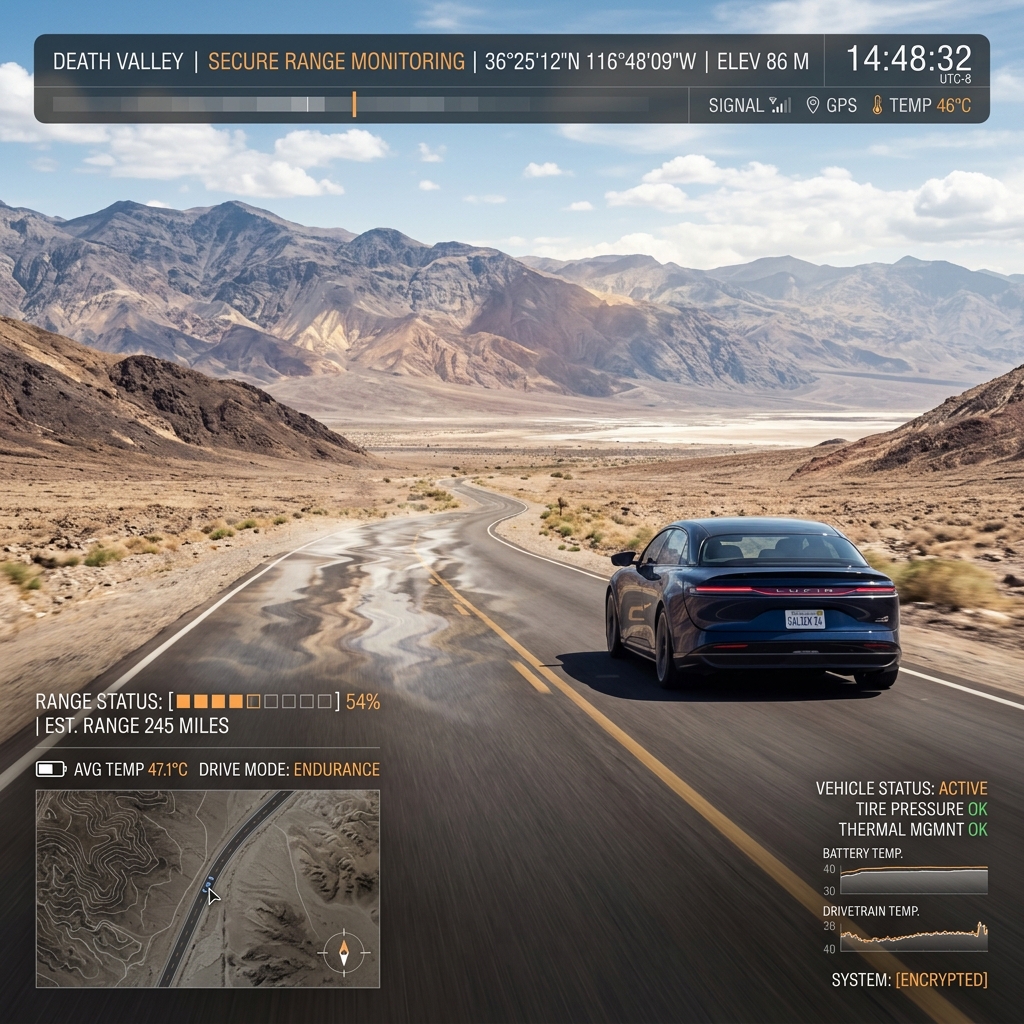
How to Drive an EV Through Death Valley Without Running Out of Charge
Essential survival guide for electric vehicles traversing Death Valley National Park. Tips on extreme heat management, charging nodes, and altitude drops.