How Much Battery Does an EV Lose Driving Uphill vs Regenerative Braking Downhill?
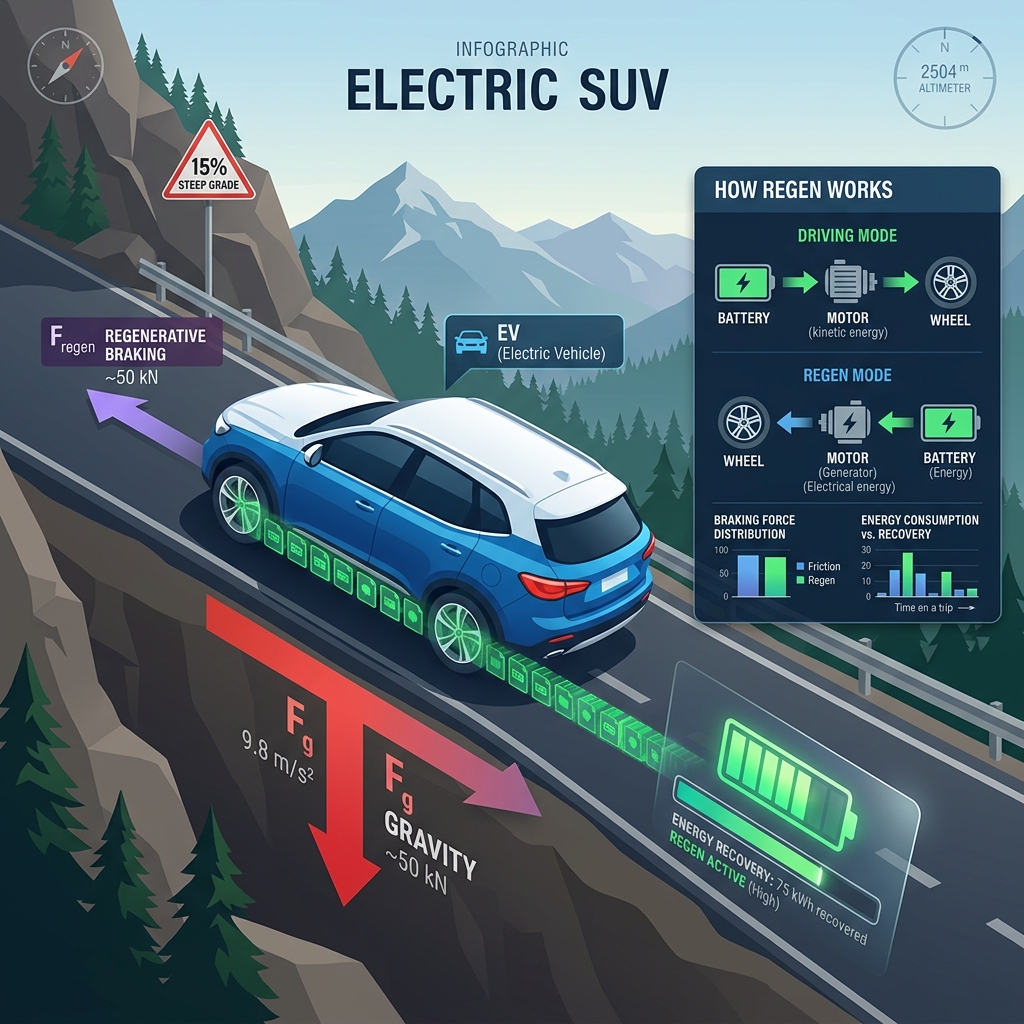
One of the most counterintuitive experiences for a first-time electric vehicle driver is watching the battery percentage drop rapidly on a mountain climb, only to see it rise or remain steady during the descent. In a traditional combustion car, braking down a mountain simply converts kinetic energy into waste heat through the brake pads. In an EV, the motor runs in reverse, acting as a generator to convert gravitational potential energy back into chemical energy stored in the battery.
But how efficient is this process? Do you recover all the energy you lost climbing? In this guide, we break down the physics of uphill energy consumption, examine the efficiency of regenerative braking, and use real-world mountain pass data to show the math behind altitude changes.
The Physics of Uphill Driving: Working Against Gravity
When driving on a flat road, your EV only needs to overcome two forces:
- Aerodynamic Drag: Resistance from pushing through the air (which increases exponentially with speed).
- Rolling Resistance: Friction between the tires and the pavement.
However, when you start climbing an incline, a third force is introduced: Gravity. The energy required to lift a mass (the weight of your vehicle) to a height is defined by the gravitational potential energy formula:
Where:
- is the energy in Joules (which can be converted to kilowatt-hours, kWh).
- is the mass of the vehicle in kilograms (kg).
- is the acceleration due to gravity ().
- is the vertical height gained in meters (m).
The Uphill Math Example
Let's take a typical mid-sized EV, like a Tesla Model Y, which weighs approximately 2,000 kg (4,400 lbs) including passengers and cargo.
If you climb a mountain pass with a vertical rise of 1,000 meters (about 3,280 feet), the potential energy required to lift the vehicle is:
Since , we divide the result:
This means that purely to fight gravity, the motor must consume 5.45 kWh of battery energy. This is in addition to the energy normally required to cover the flat distance of the climb. If the pass is 10 miles long and your car averages 3 mi/kWh on flat ground, you would normally use 3.33 kWh. Thus, your total consumption for the 10-mile climb will be:
This represents a nearly 160% increase in energy consumption.
The Downhill Math: Regenerative Braking Recovery
When you descend the other side of the mountain pass, the gravitational potential energy is released. Instead of using the friction brakes, you lift your foot off the accelerator, allowing the electric motor's magnetic resistance to slow the car down, generating electricity.
However, energy conversion is never 100% efficient. The process of converting mechanical energy back into battery charge involves three main losses:
- Motor/Generator Losses: The efficiency of the electric motor acting as a generator (typically 90% to 95%).
- Inverter Losses: Converting the AC power generated by the motor into DC power for the battery (typically 95% to 98%).
- Battery Chemical Resistance: The efficiency of the battery accepting charge (typically 90% to 95%, though this drops significantly if the battery is cold).
When you multiply these factors, the round-trip efficiency of regenerative braking is typically 60% to 70%.
The Downhill Calculation
Using our 1,000-meter descent example: The potential energy available is the same 5.45 kWh. With a regeneration efficiency of 65%, your battery will capture:
Meanwhile, you still need to cover the 10-mile distance. Since you are going downhill, the motor does not need to work to overcome rolling resistance or drag (gravity is doing that). The net energy added back to your battery during the descent will be:
3.54 \text{ kWh (regen)} - 1.0 \text{ kWh (minor auxiliary systems & drag losses)} = 2.54 \text{ kWh}
So, while you lost 8.78 kWh going up, you recovered 2.54 kWh (net positive) coming down. The net cost of the round trip over the pass is 6.24 kWh, which is still higher than the 6.66 kWh it would have taken to drive 20 miles on flat ground.
Real-World Example: Pikes Peak Descent
A famous demonstration of this math occurs on Pikes Peak in Colorado. The descent from the summit (14,115 feet) to the toll gate (7,800 feet) features a vertical drop of 6,315 feet (1,925 meters).
EV drivers regularly descend Pikes Peak and report gaining 6% to 10% of battery capacity (approximately 5 kWh to 8 kWh of energy) back into their packs by the time they reach the bottom, with their brake rotors remaining completely cool.
Key Mountain Driving Planning Tips
- Do Not Start a Descent with a 100% Battery: If your battery is fully charged, there is no space to store regenerative energy. The car will disable regeneration, forcing you to rely entirely on mechanical brakes, which can overheat on long descents. Charge to no more than 80% to 85% at the summit.
- Plan for the Peak, Not the Destination: When planning a route over a pass, ensure you have enough charge to reach the summit. Do not worry about having enough to reach the town on the other side, as you will gain charge on the way down.
- Monitor Battery Temperature: Heavy regeneration on long descents can heat up the battery pack. Keep an eye on your vehicle's thermal indicators.
Related Guides
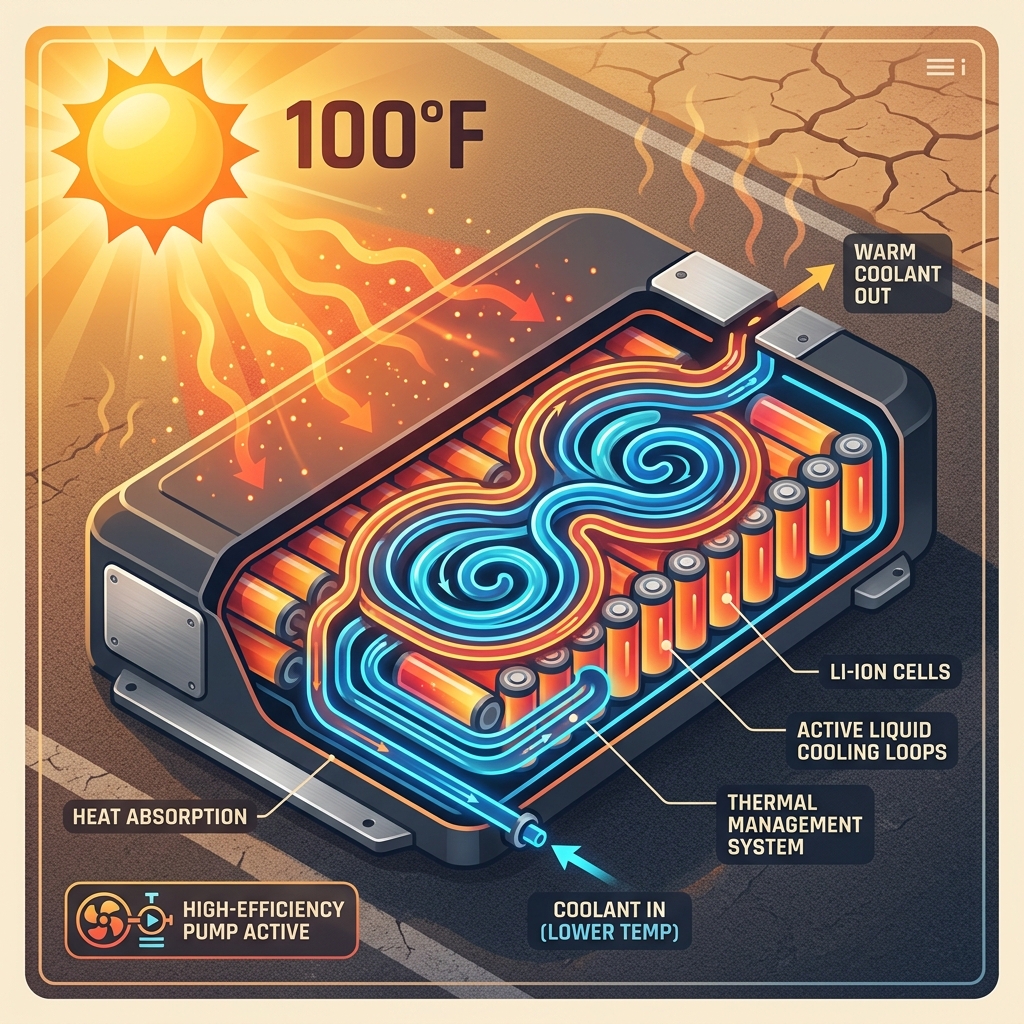
How Summer Heat Waves Degrade Lithium-ion EV Battery Lifespans
Understand how sustained temperatures above 100 degrees Fahrenheit increase battery cell degradation rates, speed up capacity loss, and impact daily range.

Why You Should Charge LFP Batteries to 100% Weekly (And Why It Ruins NMC Packs)
Discover the electrochemical reasons why LFP batteries thrive when charged to 100% weekly to calibrate SoC sensors, while NMC packs experience accelerated degradation.

LFP vs. NMC Winter Performance: Why Entry-Level EVs Drop More Range in the Cold
Understand the electrochemical differences between LFP and NMC batteries, why standard range EVs experience steeper winter range drops, and cold weather optimization.