CCS to NACS Adapter: Complete Safety and Compatibility Guide
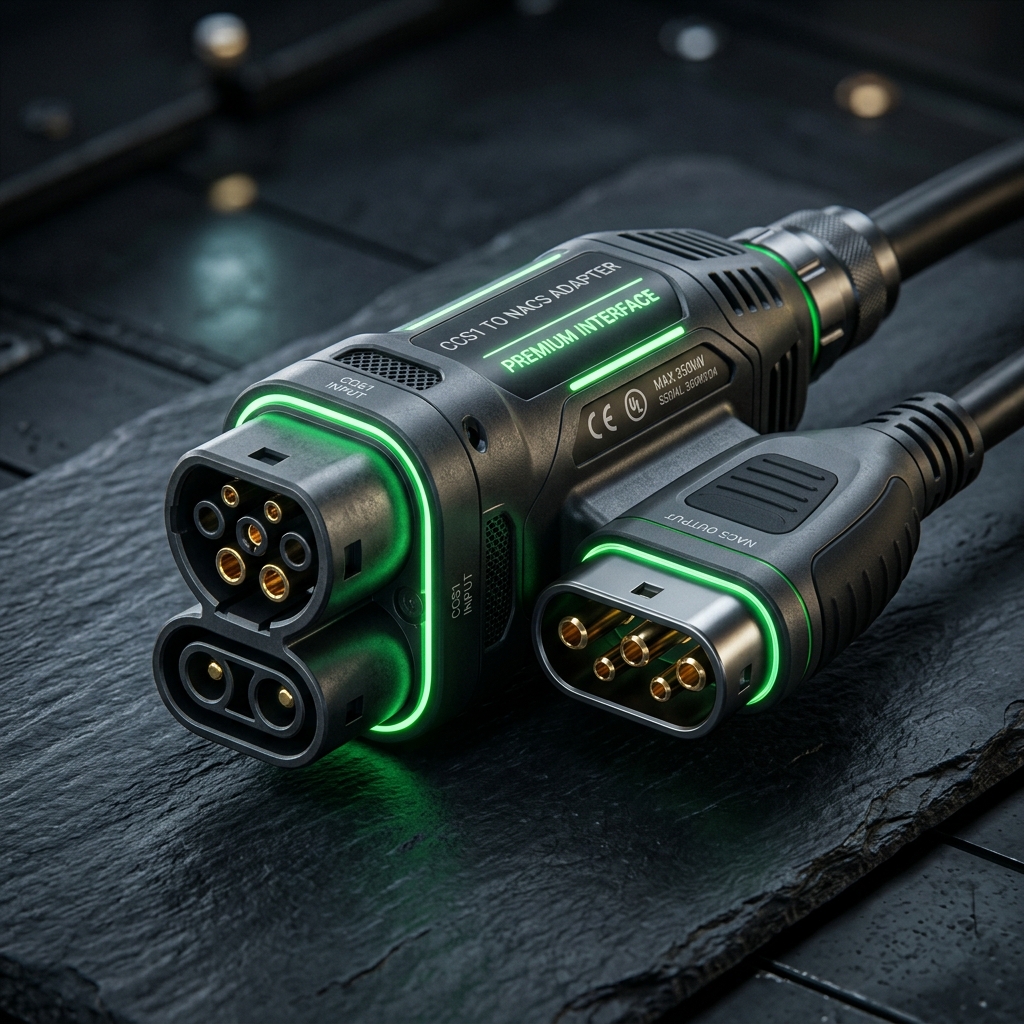
The North American electric vehicle charging landscape has undergone a monumental shift. What began as Tesla's proprietary charging plug has been standardized as SAE J3400, better known as the North American Charging Standard (NACS). Almost every major automaker selling EVs in North America has committed to transitioning their future vehicles to native NACS ports.
During this transition, millions of existing EVs equipped with the Combined Charging System (CCS1) port will need to use adapters to access Tesla's Supercharger network. In this guide, we outline which adapters you need, how manufacturer rollouts work, safety considerations when using high-power adapters, and a compatibility matrix.
Part 1: The SAE J3400 (NACS) Standardization & Historical Transition
To understand the current state of EV charging, we must trace how the industry consolidated around two competing plug designs. Historically, North American electric vehicles were split: Tesla vehicles utilized a proprietary, slim connector capable of both AC and DC charging, while other manufacturers adopted the Combined Charging System Type 1 (CCS1) standard.
CCS1 was designed as an extension of the J1772 AC charging plug. To enable DC fast charging, engineers added two large DC power pins underneath the existing J1772 housing. This resulted in a bulky, heavy, and physically complex connector that required separate ports for AC home charging and DC highway charging on the vehicle side.
In November 2022, Tesla opened its proprietary connector design to the public, rebranding it as the North American Charging Standard (NACS). The design was subsequently adopted by the Society of Automotive Engineers (SAE) and standardized as SAE J3400. The J3400 standard defines not only the physical dimensions of the plug but also:
- Support for single-phase AC charging at typical home voltages (120V / 240V).
- Support for three-phase AC charging (popular in commercial settings).
- DC fast charging up to 1000 Volts and 1000 Amps.
- The communication protocols required to negotiate power transfer.
By consolidating both AC and DC charging onto the same two primary pins, J3400 eliminates the need for separate pins, allowing for a much lighter, more compact plug that is significantly easier to handle.
Part 2: The Electro-Mechanical Architecture of the Adapter
A CCS-to-NACS adapter is not a simple plastic sleeve; it is a high-power electrical bridge designed to handle extreme currents and voltages.
       +---------------------------------------------+
       |             CCS-to-NACS ADAPTER             |
       |                                             |
       |  [NACS Inlet]  ===========>  [CCS1 Outlet]  |
       |  DC+/AC_L1     ===========>  DC+ Pin        |
       |  DC-/AC_L2     ===========>  DC- Pin        |
       |  Control Pilot ===========>  CP Pin         |
       |  GND           ===========>  PE (Ground)    |
       |  Temp Sensors  ===========>  BMS Throttling |
       +---------------------------------------------+
1. High-Current Pin Mapping
The primary function of the adapter is to route the heavy DC power lines from the Tesla NACS plug to the corresponding pins on the CCS1 port. The physical pin mapping is structured as follows:
- NACS Pin 1 (DC+/AC_L1) maps directly to the CCS1 DC+ Pin.
- NACS Pin 2 (DC-/AC_L2) maps directly to the CCS1 DC- Pin.
- NACS Ground (GND) maps directly to the CCS1 Protective Earth (PE) pin.
- NACS Control Pilot (CP) maps to the CCS1 CP pin.
Because NACS uses the same pins for both AC and DC, the adapter must physically isolate the AC contact paths during a DC charging session. High-quality adapters use copper contacts plated in silver or nickel to minimize contact resistance, which is the primary cause of thermal buildup.
2. Signal Translation & Communication Protocols
Electric vehicles negotiate charging parameters with the charging station using specific communication protocols. The adapter must allow these signals to pass through unimpeded:
- CCS1 Vehicles: Utilize Powerline Communication (PLC) over the Control Pilot pin, following the DIN 70121 and ISO 15118 protocols.
- Tesla Superchargers (V3 & V4): Support dual communication protocols. They natively speak Tesla's proprietary protocol for Tesla vehicles, but also support PLC (ISO 15118) for CCS-compatible vehicles.
- Legacy Superchargers (V2): Only speak Tesla's proprietary CAN-bus based protocol. Because they cannot speak PLC, CCS vehicles cannot charge at V2 Superchargers, even with a physical adapter.
The adapter itself does not perform signal processing or protocol translation. Instead, it provides a low-impedance channel on the CP pin, allowing the PLC signal from the car's onboard computer to establish a direct connection with the Supercharger's controller.
3. Thermal Monitoring Electronics
High-power DC charging generates heat. The formula for resistive heat dissipation in an electrical contact is:
Where:
- is the current in Amps (up to 350A to 500A).
- is the contact resistance in Ohms (typically in the micro-Ohm range).
If an adapter has a contact resistance of just (), charging at 400 Amps will generate:
This heat is concentrated in a very small area. If left unchecked, it can melt plastic housings and damage the vehicle port.
To prevent this, high-quality adapters feature dual internal Negative Temperature Coefficient (NTC) thermistors. These thermistors monitor the temperature of the internal copper pins. If the temperature exceeds a safety threshold (typically 185°F / 85°C), the resistance of the thermistor shifts. This shift is detected by the vehicle's charge port controller, which immediately commands the Supercharger to throttle down the current or terminate the session.
Part 3: Transient Thermal Modeling & Heat Rise Equations
To understand the safety bounds of high-power charging, we must model the heat generation and dissipation inside the adapter over time. The transient temperature rise of the copper terminals can be represented by the first-order thermal differential equation:
Where:
- is the thermal capacitance (heat capacity) of the copper pins in Joules per Kelvin (J/K).
- is the heat generation rate in Watts (W).
- is the instantaneous pin temperature in Kelvin (K).
- is the surrounding air temperature.
- is the total thermal resistance to the environment in Kelvin per Watt (K/W), representing heat conduction through the cable copper and convection cooling from the adapter's outer shell.
Solving this differential equation under a constant current load yields the temperature curve over time :
Where:
- is the thermal time constant of the system.
For a high-quality adapter, is approximately 10 to 15 minutes. This means the temperature reaches 63.2% of its maximum steady-state value in roughly 12 minutes. If you plug in a vehicle with a flat charging curve (e.g. pulling 350A continuous for 40 minutes), the temperature will eventually plateau:
If contact resistance rises due to micro-corrosion or wear to , the temperature plateau will exceed the safe thermoplastic deformation limit of the housing. This shows why temperature-activated current throttling (BMS-controlled safety cutoffs) is crucial.
Part 4: UL 2252 Safety Certification Demystified
The Underwriters Laboratories (UL) established the UL 2252 standard specifically to govern high-voltage EV adapters. If an adapter does not carry this certification, it represents a significant safety risk.
Required Tests for UL 2252 Compliance
To receive certification, an adapter must pass several demanding tests:
- Drop & Impact Testing: The adapter is conditioned at extreme cold temperatures (-31°F / -35°C) and dropped repeatedly from a height of 1 meter onto a concrete floor. It must not crack, expose internal conductors, or deform.
- Over-Current Endurance: The adapter must carry 125% of its rated current (e.g., 625 Amps for a 500A-rated adapter) for sustained periods without exceeding safety temperatures.
- Water Ingress (IP Ratings): High-power adapters must be rated at least IP54 (splash-resistant) or IP67 (dust-tight and water-immersion proof) when mated to the vehicle. This ensures rain cannot enter the high-voltage connections.
- Cyclical Insertion Wear: The contacts are plugged and unplugged 10,000 times to simulate years of daily use. After the test, the mechanical mating force and contact resistance must remain within design limits.
- Flame Retardancy: The plastic housing must be composed of self-extinguishing materials (UL 94 V-0 rating) that will not sustain a flame if exposed to fire.
Part 5: Vehicle-by-Vehicle Manufacturer Matrix
The rollout of NACS access is occurring in phases. The following matrix details the current status and roadmap for major automotive groups.
| Brand Group | Access Status | Official Program Details | Software Integration | Third-Party Stance | | :--- | :--- | :--- | :--- | :--- | | Ford | Active | Free adapters provided to owners; shipping in batches. | Plug & Charge enabled via FordPass app. | UL 2252 certified only. | | Rivian | Active | Free adapters shipped to R1T/R1S owners. | Integrated into dashboard routing. | UL 2252 certified only. | | General Motors | Active | Available to order via brand apps for $225. | Superchargers show in Chevy/GMC navigation. | GM-approved adapters recommended. | | Hyundai / Kia | Active / Rolling Out | Shipping adapters to new 2025/2026 EV owners. | Native map updates showing NACS locations. | UL 2252 certified only. | | Volvo / Polestar | Active / Rolling Out | Customer orders open; shipping throughout 2026. | Google Automotive OS integration. | UL 2252 certified only. | | Audi / Porsche / VW | Mid-2026 | Adapters planned for purchase via dealership networks. | MyAudi / MyPorsche app updates. | Official adapters recommended. | | Mercedes-Benz | Mid-2026 | Adapters available to Mercedes EV owners. | Integrated Mercedes me Charge payment. | Official adapters recommended. | | BMW / Mini / Rolls-Royce | Late-2026 | Planned adapter release for all active EV lines. | BMW Charging App integration. | No third-party support. | | Lucid | Late-2026 | Lucid-branded adapters available for purchase. | Lucid Air navigation updates. | UL 2252 certified only. | | Toyota / Lexus | Late-2026 | Adapters provided for bZ4X and RZ owners. | Toyota App payment support. | No third-party support. | | Nissan | Late-2026 | Adapters planned for Ariya owners. | NissanConnect App integration. | No third-party support. |
Part 6: Supercharger Etiquette, Charging Physics, and Cable Obstacles
Using an adapter at a Supercharger requires understanding the physical layout differences between Tesla and non-Tesla EVs.
1. The Cable Length Problem
Tesla Supercharger cables are short (typically 6.5 feet long) because Tesla vehicles always feature the charge port in the rear-left corner (or front-right for Cybertruck). This layout allows Tesla drivers to back directly up to the charger stall and plug in without extra cord length.
However, non-Tesla vehicles feature charge ports in various locations:
- Ford F-150 Lightning: Front-left.
- Rivian R1T / R1S: Front-left.
- Hyundai Ioniq 5: Rear-right.
- Porsche Taycan: Front-right/Front-left.
If you drive a Rivian or Ford and back into a standard V3 Supercharger stall, the short cable will not reach your front-left port. To plug in, you must park in the stall immediately to the right, occupying a second stall. This is known as "stall sharing."
   Stall 1 [Tesla]       Stall 2 [Rivian]       Stall 3 [Empty]
      |                     |                      |
   [Cable]               [Cable]                [Cable]
      |                     +--> [Front-Left Port] |
      |                            (Occupies Stall 2)
      +--> [Rear-Left Port]
Best Practices for Stall Sharing:
- Use the End Stall: If available, park at the far right-hand end stall. This allows you to plug in without blocking an adjacent parking space.
- Avoid Peak Hours: Try to charge when Supercharger occupancy is below 50%.
- Use V4 Superchargers: V4 Supercharger cabinets feature longer, 10-foot cables designed specifically to reach ports on any vehicle corner.
2. Charging Curves: V3 vs. V4 Performance
Charging speeds are determined by the vehicle's battery voltage and the Supercharger's maximum current limits:
- Tesla V3 Superchargers: Have a maximum current output of approximately 425 Amps at 400V. For 800V vehicles (like the Hyundai Ioniq 5, Kia EV6, or Porsche Taycan), V3 Superchargers are limited because they must down-convert their voltage. These vehicles will be capped at approximately 97 kW to 100 kW, far below their maximum 240+ kW capabilities.
- Tesla V4 Superchargers: Natively support up to 1000V DC power, allowing 800V vehicles to charge at their full potential, provided the vehicle software and adapter support the higher voltage.
Part 7: Troubleshooting Connection Failures & Fault Codes
Using an adapter adds mechanical connections. Understanding the diagnostic signals on the charger post and vehicle dashboard helps isolate faults.
1. Common Charger Status Indicators
- Solid Red Ring (Supercharger Post): Indicates a critical fault. The post failed the insulation resistance check.
- Cause: The adapter is not locked tightly, or dirt/water has bridged the contacts.
- Fix: Unplug, verify contacts are clean and dry, slide the latch lock forward fully until it clicks, and reinsert.
- Flashing Blue Light (Vehicle Port): The vehicle is ready to charge, but is waiting for authorization.
- Cause: The payment app (Tesla App or OEM Pass) has not completed card validation.
- Fix: Open your app and confirm the session has been authorized for that specific stall number.
- Amber/Orange Light (Vehicle Port): Connection failure.
- Cause: The PLC handshake timed out. This often happens if the adapter is inserted too slowly, triggering a proximity sensor warning before communication starts.
- Fix: Unplug, wait 10 seconds, and insert the plug firmly in a single, continuous movement.
2. Physical Maintenance Protocols
- Debris Evacuation: EV charge ports are exposed to outdoor environments. Regularly spray compression air into the adapter channels to blow out leaves, dust, or spider webs.
- Oxidation Mitigation: If the silver-plated copper pins look dull or black, apply a small drop of specialized electrical contact cleaner to a microfiber cloth and wipe the terminal interiors. Do not use metal scrapers or screwdrivers as this will scratch the plating, increasing contact resistance and thermal output.
Part 8: Mechanical Anatomy & Structural Wear Analysis
An adapter must survive significant physical abuse. The mechanical design features specific engineering attributes to guarantee longevity:
1. Mating Force Tolerances
- Insertion Force: Inserting a NACS connector into the adapter's inlet socket requires approximately 15 to 20 pounds of linear force.
- Extraction Force: Pulling the connector out requires 10 to 15 pounds of force when the safety locks are disengaged.
- Why this matters: If the mating force is too low, the connection will be loose, causing electrical arcing. If too high, the driver will struggle to connect. High-quality adapters use spring-loaded internal contacts to maintain constant pressure.
2. Impact-Resistant Engineering
- Housing Shell: Constructed from high-density polycarbonate and PBT (polybutylene tape) blends. This material retains structural flexibility at sub-zero temperatures, preventing cracking when dropped.
- Weather Sealing: A premium silicone gasket is located inside the CCS1 outlet barrel. When inserted into the car, the gasket compresses to form a watertight seal, blocking rainwater from the high-voltage terminals.
Part 9: Manufacturing Quality Control Protocols
High-volume manufacturing of high-voltage automotive accessories requires strict quality control systems.
1. Dielectric High-Potential (Hi-Pot) Testing
Every adapter must pass a Hi-Pot test before leaving the factory. This test applies a high voltage (typically 3,000 Volts AC or 4,200 Volts DC) between the primary DC power pins and the communication/ground pins for 60 seconds. The leakage current must remain below 1 milliamp (mA). This verifies that the internal insulation barriers are free of microscopic voids or assembly cracks.
2. Ultrasonic Welded Terminals
Connecting the internal NACS copper contacts to the CCS terminal plates requires high-strength joints. Standard soldering or mechanical crimping is insufficient because it introduces micro-gaps that increase contact resistance. Instead, manufacturers utilize ultrasonic metal welding. High-frequency acoustic vibrations weld the copper components at a molecular level, creating a solid joint with near-zero contact resistance.
Part 10: Environmental Durability & Longevity Stress Tests
Public charging adapters are exposed to outdoor environments year-round. High-quality manufacturers perform specific environmental tests:
1. Thermal Shock Cycling
Adapters are subjected to rapid temperature changes, transitioning between -40°F (-40°C) and +185°F (+85°C) in under 10 seconds. The cycle is repeated 200 times. This simulates moving the adapter from a warm car cabin to sub-zero outdoor air, ensuring the different thermal expansion rates of the copper pins and plastic housing do not cause cracking or seal separation.
2. Salt Spray Corrosion Testing
To ensure reliability in coastal regions or areas where road salt is used, adapters are exposed to a 5% sodium chloride salt spray chamber for 500 hours at 95°F (35°C). The copper contacts must not corrode, and the silver plating must retain its low contact resistance to prevent thermal hazards.
3. UV Stabilization
The outer housing is formulated with UV-stabilizing compounds. It is exposed to concentrated xenon arc lamps (simulating 5 years of intense sunlight). This prevents the plastic from becoming brittle, fading, or losing its drop-test impact resistance.
Part 11: Comprehensive Adapter FAQs
Q1: Can I use a NACS-to-CCS adapter at home on my Level 2 charger?
No. High-power DC fast-charging adapters are designed specifically for DC charging. For home charging (AC Level 2), you must use an AC-specific adapter (such as a J1772-to-NACS or NACS-to-J1772 adapter). These do not feature the heavy internal copper routing required for high-voltage DC currents.
Q2: What is the difference between a "Magic Dock" and a separate adapter?
A Magic Dock is a built-in adapter integrated directly into the Supercharger post. When a non-Tesla driver selects that stall in the Tesla app, the Supercharger releases the cable with the CCS adapter permanently locked onto it. A separate adapter is a device owned by the EV driver that they plug into their car port before attaching the Supercharger cord.
Q3: Why are V2 (150 kW) Superchargers incompatible with non-Tesla EVs?
V2 Superchargers utilize Tesla's proprietary CAN-bus communication protocol. They do not have the hardware required to translate Powerline Communication (PLC) signals used by CCS1 vehicles. Because the car and charger cannot communicate, no power transfer can be initiated.
Q4: What happens if I use an uncertified third-party adapter?
Using an uncertified adapter poses significant risks, including:
- Overheating: Poor contact fitment can cause high electrical resistance, leading to melted charge ports or vehicle fires.
- Mechanical Damage: Cheap plastics can crack or seize inside the car's charge port, requiring expensive repairs.
- Warranty Voiding: Most automakers state that damage caused by uncertified charging accessories is not covered by the vehicle warranty.
Q5: Do adapters restrict charging speeds?
No, provided the adapter is rated for the current you are drawing. High-quality adapters are rated for 500 Amps continuous, which matches or exceeds the maximum current output of V3 and V4 Supercharger cabinets.
Q6: Can I leave my adapter plugged into my car's charge port when not charging?
It is not recommended. Leaving the adapter plugged in exposes the internal terminals to dust, moisture, and road debris. Always store the adapter in its protective case when not in use.
Q7: Are adapters waterproof?
Adapters are designed to be weather-resistant (typically IP54 or IP67 rated) when fully mated to the vehicle. However, they should not be submerged in water or plugged in during severe, flooding downpours where water can accumulate inside the connector ports.
Q8: Why does the Supercharger take several seconds to start charging when using an adapter?
When you plug in, the vehicle and the Supercharger must perform an insulation test to check for electrical shorts, followed by a software handshake (PLC communication). This handshake takes 10 to 30 seconds to complete before the contactors click shut and power begins to flow.
Q9: Can I use a CCS-to-NACS adapter at a Tesla Destination Charger?
No. Destination Chargers are Level 2 AC units located at hotels and restaurants. They use AC power. You must use an AC-compatible adapter (such as a NACS-to-J1772 adapter) to charge at these locations.
Q10: How do I lock my adapter to prevent theft during a charging session?
Most vehicles automatically lock the charge port connector when the doors are locked. High-quality adapters also feature physical lock tabs that prevent the NACS cable from being detached from the adapter unless the vehicle command unlocks the port.
Q11: What should I check before purchasing a third-party adapter?
Ensure the adapter has UL 2252 certification, is rated for at least 500A / 1000V DC, features dual NTC temperature sensors, and has positive user reviews for fitment.
Q12: Can I use an adapter to charge a Tesla vehicle at a CCS1 fast charger?
Yes, but you will need the opposite adapter: a CCS1-to-NACS adapter (often sold directly by Tesla). This allows a Tesla vehicle to plug into Electrify America, EVgo, or ChargePoint CCS chargers.
Q13: What is "thermal throttling" during a charging session?
If the temperature sensors inside the adapter detect heat exceeding safety limits, the vehicle commands the charger to reduce the current (Amperage). You will see your charging speed drop (e.g. from 150 kW down to 50 kW) to allow the contacts to cool.
Q14: How does dirt or dust affect the adapter?
Dirt, dust, and corrosion on the copper pins increase contact resistance, which leads directly to heat buildup. Keep the terminals clean and dry.
Q15: Why is the NACS connector so much smaller than CCS?
NACS combines the AC and DC power paths onto the same two large pins, whereas CCS uses separate pins for AC and DC. By consolidating the pathways, NACS requires fewer terminals and a much smaller physical footprint.
Q16: Will my automaker replace my third-party adapter if it fails?
No. Automakers only cover their official, branded adapters. If a third-party adapter fails, you must contact the manufacturer of that specific adapter.
Q17: Can I use an adapter at a Tesla Supercharger in Europe?
No. European Tesla Superchargers and European EVs use the CCS2 standard, which has a different pin layout and physical shape than North American CCS1 and NACS connectors. Adapters designed for North America will not work in Europe.
Q18: What is the life expectancy of a high-quality adapter?
UL 2252 testing requires the adapter to survive 10,000 insertions, which equates to roughly 10 to 15 years of normal daily road trip use.
Q19: Can I charge two vehicles simultaneously using one adapter?
No. The adapter is a point-to-point interface designed to connect a single vehicle port to a single charging cable.
Q20: What should I do if the adapter gets stuck in my car's charge port?
Do not pull aggressively. Check that your vehicle is unlocked, press the stop charging command on the car's screen, and pull the manual release cable located inside your vehicle's trunk/hood area if necessary.
Q21: What is the maximum voltage supported by NACS adapters?
Most certified NACS adapters are rated for up to 1000 Volts DC, making them compatible with next-generation high-voltage battery architectures.
Q22: Are there adapters that support liquid cooling?
No. Liquid cooling is integrated into the Supercharger station's cable and cabinet, not the adapter. Because the adapter is a short, solid-state bridge, it relies on high-quality copper terminals and thermal sensors to manage temperatures.
Q23: Why do some adapters have a sliding lock?
The sliding lock ensures the Tesla NACS latch mechanism is physically secured to the adapter, preventing accidental disconnection during high-power charging.
Q24: How heavy is a CCS-to-NACS adapter?
Most adapters weigh between 1.5 and 2.5 pounds, making them very easy to store in a glovebox or door pocket.
Q25: Can I plug my adapter into an extension cord?
Absolutely not. You must never use extension cords or intermediate vehicles between the Supercharger cord, the adapter, and the vehicle. High-power DC fast charging requires a direct connection to ensure safety.
Q26: What is SAE J3400?
SAE J3400 is the official engineering standard designation for the North American Charging Standard (NACS) plug, established by the Society of Automotive Engineers.
Q27: How does the adapter impact the vehicle's battery health?
The adapter is a passive electrical link and does not affect battery health. Battery health is managed entirely by the vehicle's onboard battery management system (BMS).
Q28: Can I use an adapter if my car's charge port has minor physical damage?
No. If your car's charge port has cracked plastic or bent pins, using an adapter can cause poor contact mating, increasing resistance and safety risks. Have the port repaired first.
Q30: Do adapters work in sub-zero temperatures?
Yes, certified adapters are rated to operate down to -31°F (-35°C). However, the cable and adapter plastic will be stiffer, requiring more force to plug in.
Q31: How do I know if my EV supports Plug & Charge at Superchargers?
Check with your vehicle manufacturer. Currently, Ford and Rivian support Plug & Charge. Once enabled in your account, you simply plug in, and the station bills your card automatically.
Q32: Why does the adapter feel warm to the touch after charging?
It is normal for the adapter to feel warm (up to 120°F / 50°C) after a high-power charging session due to current transfer. If it feels hot or smells like burning plastic, terminate the session immediately.
Q33: Are there any federal subsidies for purchasing an adapter?
Currently, there are no specific federal rebates for purchasing adapters, though some utility companies offer rebates for home charging accessories.
Q34: What materials are used to make the adapter contacts?
They are made of high-conductivity copper alloys, often plated with silver or nickel to prevent oxidation and minimize contact resistance.
Q35: Can I use the adapter at an Electrify America station?
No. Electrify America stations feature native CCS1 cables. You only need the adapter when using a Tesla Supercharger cable.
Q36: Will using an adapter reduce my overall charging speed compared to a native NACS vehicle?
No. The adapter conducts electrical current and does not limit speed. The charging rate is negotiated directly between the vehicle's battery management system (BMS) and the charger cabinet based on battery temperature, state of charge, and hardware limits.
Q37: Can I use the adapter if it is snowing?
Yes. Rain and snow do not affect charging safety when using a certified IP-rated adapter. The rubber sealing gaskets prevent moisture from reaching the electrical pins.
Q38: Are third-party adapters covered by vehicle insurance if they cause damage?
This depends on your specific automotive insurance policy. Typically, comprehensive coverage covers vehicle damage, but the insurer may seek reimbursement from the adapter manufacturer if it is found to be uncertified or defective. Always use certified equipment to avoid liability disputes.
Q39: What is the maximum current rating for standard NACS adapters?
The current standard for high-speed NACS-to-CCS1 adapters is 500 Amps continuous, matching the peak current output of V3/V4 Superchargers.
Q40: Can I use the adapter on an EV conversion project?
Yes, provided the conversion uses a standard CCS1 charging system and handles the necessary PLC communication to negotiate power with the charging station.
Q41: How do I know if my adapter is UL 2252 certified?
Look for the holographic UL mark or listing symbol printed on the adapter body. You can also verify the manufacturer's name and model number on the online UL Product iQ directory.
Q42: Is there a danger of electrical shock when handling the adapter?
No. The high-voltage pins inside the adapter are recessed, and no power flows through the terminals until the adapter is plugged in and a secure handshake is established.
Q43: What should I do if my adapter gets wet inside the contacts?
Do not plug it in. Shake out the water and let it dry completely in a warm, ventilated space. Do not use hair dryers or heating elements to dry it as this can warp the plastic.
Q44: Can I paint my adapter to match my car?
Do not paint the adapter. Paints contain solvents that can degrade the structural polycarbonate plastics, and paint layers can cover warning labels or safety certification markings.
Q45: Does the adapter support three-phase power?
No. High-speed DC adapters only route positive, negative, ground, and communication pins. Three-phase power is an AC standard.
Q46: What is high-potential testing?
High-potential (hi-pot) testing is a safety test where high voltage is applied to verify electrical insulation barrier strength.
Q47: What is contact resistance?
The physical resistance at the interface of electrical contact surfaces. Minimizing contact resistance prevents thermal build-up.
Q48: How does humidity affect high-voltage adapters?
High humidity can cause condensation on internal surfaces. Certified IP-sealed adapters isolate terminals from moisture.
Q49: What is ultrasonic metal welding?
A welding process using high-frequency vibrations to join metals at a molecular level, creating joints with extremely low electrical resistance.
Q50: Can I use the adapter at a local municipality charger?
Yes, if the municipality charger features a Tesla NACS plug (common on newer public Level 2 chargers or DC hubs).
Q51: How does salt spray affect the adapter casing?
Salt spray causes aggressive chemical oxidation on raw copper. High-quality adapters use silver-plated contacts to resist corrosion in coastal climates.
Q52: What is the maximum storage temperature for the adapter?
Most adapters can be safely stored in a car trunk at temperatures up to 185°F (85°C) without degrading the plastics or internal electronics.
Q53: Does the adapter casing resist motor oil or brake fluid?
Yes, the polycarbonate/PBT blend housing provides chemical resistance to standard automotive fluids, but spills should be wiped off immediately.
Q54: What is UV stabilization?
Additives blended into the plastic shell that prevent solar ultraviolet rays from making the material brittle or causing discoloration.
Q55: Can I clean the adapter in a dishwasher?
No. Dishwasher detergents are highly alkaline and will corrode the silver contact plating, while high heat can warp the silicone weather gaskets.
Part 12: Charging Standard Glossary
- NACS (North American Charging Standard): The compact plug interface developed by Tesla, standardized as SAE J3400.
- CCS1 (Combined Charging System Type 1): The legacy charging standard combining J1772 with DC pins, used in North America.
- SAE J3400: The engineering standard defining the mechanical, electrical, and signal requirements of NACS.
- DIN 70121: The German industrial standard defining the PLC communication protocol used in early CCS vehicles.
- ISO 15118: The international standard defining advanced vehicle-to-grid (V2G) and Plug & Charge communication.
- Control Pilot (CP): The physical pin used to carry communication signals between the vehicle and the charging station.
- Proximity Pilot (PP): The pin used to detect when the plug is physically inserted and locked.
- Powerline Communication (PLC): A technology that sends data signals over existing power conductors.
- NTC Thermistor: A temperature-sensitive resistor whose resistance decreases as temperature rises, used for safety monitoring.
- IP Rating (Ingress Protection): A rating classifying the degree of protection provided against dust, water, and accidental contact.
- Contact Resistance: The electrical resistance at the interface of two mating connectors, which generates heat when current flows.
- Plug & Charge: A standard allowing an EV to automatically authenticate and pay for charging simply by plugging in.
- V3 Supercharger: Tesla's 250 kW DC fast-charging cabinet that supports liquid-cooled cables and CCS communication.
- V4 Supercharger: Tesla's next-generation cabinet supporting up to 1000V DC power and longer charging cables.
- Magic Dock: Tesla's dual-connector Supercharger stall that features a built-in, lockable CCS adapter.
- J1772: The standard plug interface for North American Level 1 and Level 2 AC charging.
- CAN-bus (Controller Area Network): A robust vehicle bus standard designed to allow microcontrollers and devices to communicate.
- AC Charging: Alternating Current charging where the vehicle's onboard charger converts AC from the grid into DC for the battery.
- DC Charging: Direct Current charging where high-power external cabinets convert grid AC into DC, bypassing the vehicle's onboard charger to deliver power directly to the battery.
- SAE (Society of Automotive Engineers): A global association of engineers and technical experts in the aerospace, automotive, and commercial-vehicle industries.
- UL (Underwriters Laboratories): A global safety certification company that tests and establishes standards for electrical products.
- PBT (Polybutylene Terephthalate): A semi-crystalline engineering thermoplastic polymer used as an insulator in electrical and electronic industries.
- Silver Plating: A coating applied to terminals to provide low contact resistance and excellent corrosion protection.
- Nickel Plating: A coating applied to copper pins to provide high wear resistance and prevent corrosion.
- BMS (Battery Management System): The onboard brain that manages cell-level voltages, currents, temperatures, and state of health.
- PLC Handshake: The initial negotiation phase where car and charger establish a software connection over PLC.
- Insulation Resistance Test: A safety diagnostic check performed by the charger to detect ground faults before releasing high-voltage power.
- Amperage (Current): The volume of electrical charge flowing through a circuit per second.
- Voltage (Potential): The electrical pressure pushing current through the circuit.
- Arcing: A luminous discharge of electricity across a gap in a circuit, which can cause severe contact damage.
- IP54: An ingress protection rating indicating protection against dust deposits and water sprays from any direction.
- IP67: A high-level ingress protection rating indicating dust-tight design and survival during complete immersion in water up to 1 meter depth.
- UL 94 V-0: The highest rating for plastic flammability, indicating that burning stops within 10 seconds on a vertical specimen.
- Friction Lock: A mechanical latch system that holds the connector in place using physical friction or mechanical spring tabs.
- Slide Lock: A physical latch lock situated on the adapter to lock the NACS latch mechanism.
- Stall Sharing: When a non-Tesla EV parks off-center due to short Supercharger cords, occupying a second stall to charge.
- Transient Heat Rise: The temperature change of an electrical component before reaching thermal equilibrium.
- Thermal Capacitance: The ability of a physical body to store thermal energy, proportional to its mass and specific heat capacity.
- Thermal Resistance: The measure of a temperature difference by which an object resists a heat flow, in Kelvin per Watt.
- Hi-Pot Test: A high-potential dielectric test to verify electrical insulation integrity under high-voltage stresses.
- Leakage Current: The small current that flows through or across the surface of an insulator when voltage is applied.
- Ultrasonic Metal Welding: A solid-state welding process joining metals using acoustic vibrations to create molecular bonds.
- Polycarbonate: A group of thermoplastic polymers containing carbonate groups, characterized by high impact strength.
- DIN (Deutsches Institut für Normung): The German Institute for Standardization, which establishes technical norms and standards.
- ISO (International Organization for Standardization): An international standard-setting body composed of representatives from various national standards organizations.
- Control Pilot Line: The physical signal wire carrying duty cycle commands to control charging limits.
- Proximity Pilot Line: The connection that senses insertion status and unlocks the charging connector.
- Arrester: A safety device protecting electrical systems from lightning-induced voltage surges.
- Dielectric Strength: The maximum electric field that a pure material can withstand without experiencing electrical breakdown.
- Arc Flash: A dangerous release of energy caused by an electrical arc, producing extreme heat and pressure.
- Contact Finger: Slotted copper contacts designed to compress during insertion to maintain strong mechanical force.
- Thermal Shock Cycling: A test method checking how materials withstand rapid, severe changes in temperature.
- Salt Spray Chamber: An environmental testing chamber exposing products to a salty fog to test corrosion resistance.
- Xenon Arc Lamp: A light source used in aging tests to simulate sunlight UV exposure.
- Alkaline Detergent: High pH cleaning agents that can react with metals like copper or silver, causing corrosion.
- Hi-Pot Tester: An instrument used to apply high test voltages to confirm insulation limits.
- Dielectric Void: A pocket of air or moisture inside an insulating layer that reduces its dielectric breakdown voltage.
- Contact Finger Fatigue: The weakening of copper alloy contact fingers after thousands of insertion cycles, reducing contact pressure.
- Creepage Distance: The shortest path along the surface of an solid insulating material between two conductive parts.
- Clearance Distance: The shortest distance through air between two conductive parts, protecting against electrical arcing.
- Ohmic Heating: The heat generated by the passage of electric current through a conductor, equal to .
- CAN-bus Protocol: Controller Area Network protocol, a message-based communication standard used in Tesla vehicles and V2 Superchargers.
- ISO 15118-20: The latest revision of ISO 15118, adding support for bi-directional charging (V2G) and NACS.
- Silver Sulfide: A black chemical compound formed when silver contacts react with hydrogen sulfide in the atmosphere, increasing resistance.
- Nickel Underplate: A layer of nickel applied beneath silver plating to prevent copper from diffusing to the surface.
- Lock Actuator Solenoid: An electromagnetic actuator inside the vehicle port that physically locks the adapter in place.
Related Guides
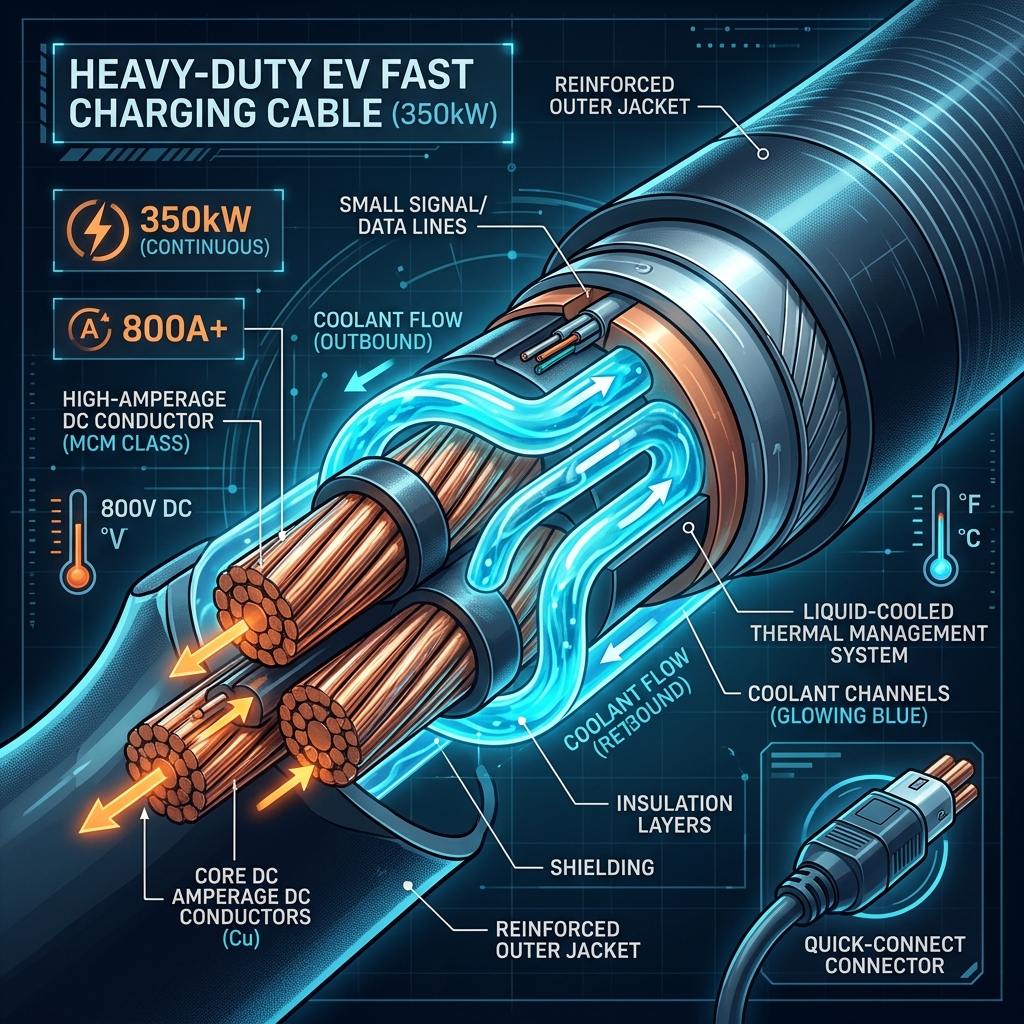
Liquid-Cooled EV Charging Cables: The Physics of Heat Dissipation
Explore the engineering behind liquid-cooled cables that allow 350kW+ DC fast charging stations to deliver high amperage without melting.
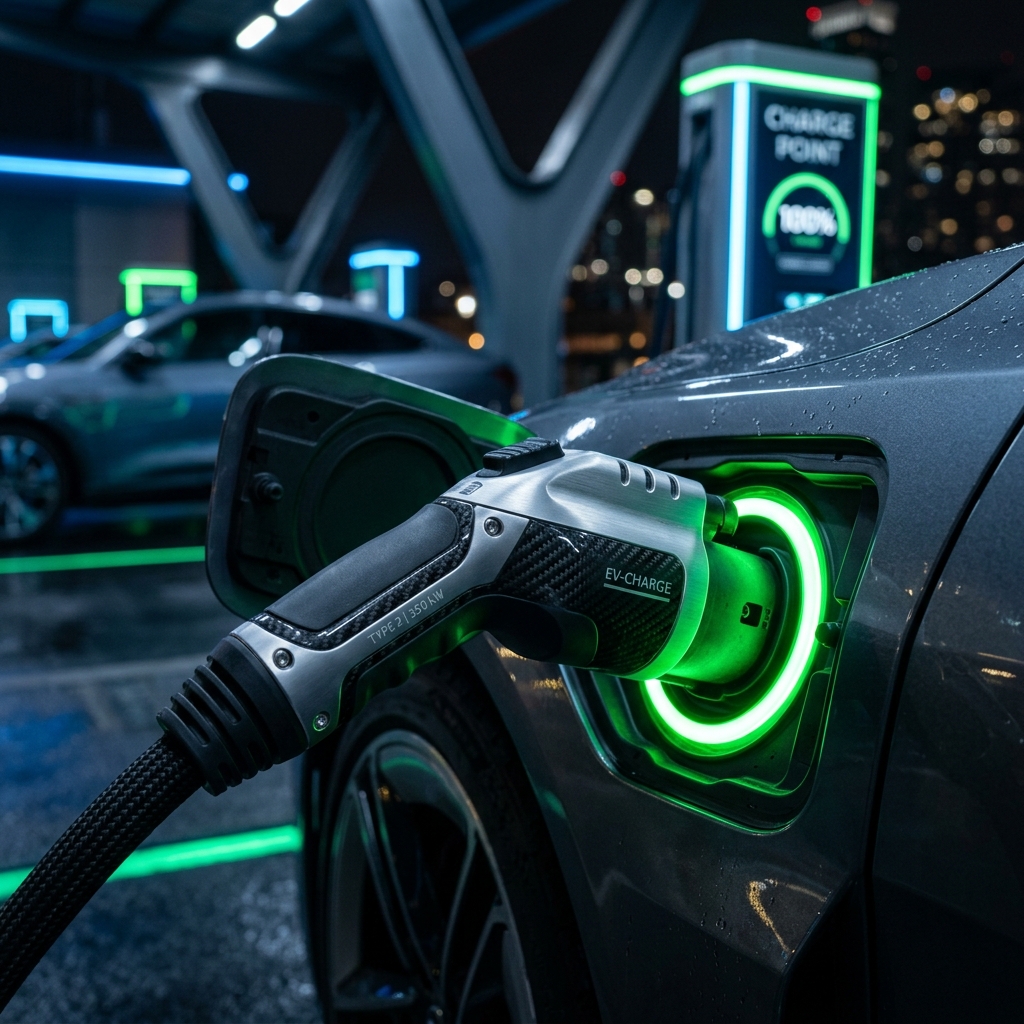
Approved vs. Cheap NACS Adapters: The Risks of Uncertified High-Power Charging
Understand the UL standards for CCS-to-NACS adapters, safety risks of uncertified plugs, and warranty implications of charging at 250kW.
The Cold Charging Bottleneck: How Preconditioning Saves 30 Minutes at DC Fast Chargers
Learn the engineering behind battery pre-conditioning, why cold cells fast-charge slowly to prevent lithium plating, and how to optimize road trip charging.