How Many Solar Panels Do I Need to Charge My EV at Home for Free?
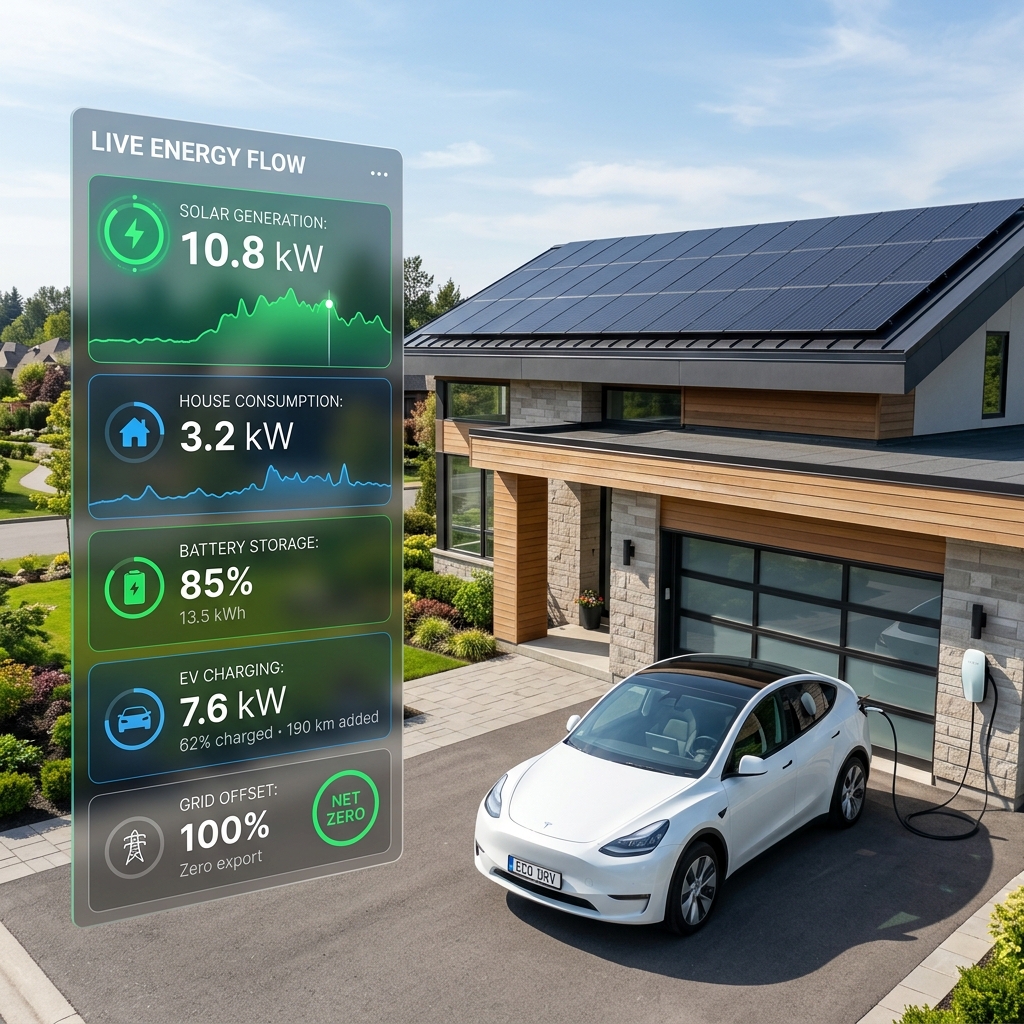
One of the greatest benefits of electric vehicle ownership is freeing yourself from volatile gasoline prices. However, charging your car at home will still increase your monthly electric bill. To achieve true energy independence and zero driving emissions, many EV owners look to pair their vehicles with home solar panels.
But how many solar panels do you actually need to charge your EV? In this guide, we walk you through a step-by-step calculation using average driving habits, EV efficiency numbers, solar irradiance metrics, and return on investment (ROI) timelines.
Part 1: The Physics and Engineering of Solar PV Cells
1. The Photovoltaic Effect & Semiconductor Bandgaps
Solar panels convert sunlight into electricity using the photovoltaic effect, which occurs within the semiconductor material (typically monocrystalline silicon). When photons of sunlight strike the solar cell, they transfer energy to electrons in the valence band of the silicon atoms, allowing them to cross the bandgap energy threshold:
This transition frees the electrons into the conduction band, leaving behind a positive "hole." The internal electric field created by the p-n junction of the solar cell sweeps the free electrons toward the negative terminal (n-type silicon) and the holes toward the positive terminal (p-type silicon), creating a direct current (DC).
2. Cell Efficiency Constraints and Temperature Coefficients
Modern residential solar panels achieve an efficiency rate of approximately 20% to 23%. This limit is defined by the Shockley-Queisser limit, which models the maximum theoretical efficiency of a single-junction solar cell under standard test conditions.
A critical engineering factor is the temperature coefficient of the solar panel. As solar panels absorb sunlight, they heat up. The power output of a photovoltaic cell drops as its temperature rises. The temperature coefficient (typically -0.35% to -0.40% per °C) defines this loss:
Where:
- is the rated panel power under Standard Test Conditions (25°C cell temperature, 1000 W/m² solar irradiance).
- is the temperature coefficient (expressed as a negative fraction, e.g. -0.0038/°C).
- is the actual operating cell temperature in °C.
On a hot summer day in Phoenix, Arizona, cell temperatures can easily reach 149°F (65°C). The power output drop for a 400W panel is:
This represents a 15.2% reduction in peak power output due to heat, demonstrating why regional sizing must account for local climate conditions.
Part 2: Advanced Sizing and System Design Calculations
To size a solar system, we must calculate three variables:
- Daily energy consumption of your EV (in kWh).
- Daily energy production of a single solar panel (in kWh).
- The number of panels required (dividing consumption by production).
Step 1: Calculate Your EV's Daily kWh Needs
According to the Federal Highway Administration, the average American drives approximately 13,500 miles per year, which breaks down to about 37 miles per day.
Next, we look at vehicle efficiency. EV efficiency is measured in miles per kilowatt-hour (mi/kWh) or watt-hours per mile (Wh/mi). A typical modern EV averages around 3.5 miles per kWh (or 285 Wh/mi).
Using these numbers, we find the daily electricity required:
To offset your daily driving, your solar panels must produce at least 10.57 kWh of electricity per day.
Step 2: Calculate Single Panel Daily Production
The amount of electricity a solar panel generates depends on its wattage rating and the amount of direct sunlight it receives, known as peak sun hours.
Let's use a standard 400-Watt (0.4 kW) solar panel as our baseline. The average US location receives approximately 4.5 peak sun hours per day.
To find a single panel's daily output, we multiply the capacity by sun hours, accounting for typical system losses (inverter inefficiency, dirt, wiring losses) which total about 20% (an 80% system efficiency factor):
Step 3: Calculate the Number of Panels
Now we divide the daily energy needed by the output of a single panel:
Rounding up, you will need 8 solar panels (rated at 400W each) dedicated solely to offset your driving. This translates to a 3.2 kW solar system.
Part 3: Sizing Home Batteries for Off-Grid Charging
Unless you work from home, your car is likely away from home during peak sunlight hours. You cannot charge the car directly from the panels in real-time. If you live in an area without net metering, or want to charge off-grid, you must store the solar energy in a home battery system.
To size the battery bank, we must model battery capacity while accounting for safety limits and losses.
1. Depth of Discharge (DoD) & Round-Trip Efficiency
A battery's usable capacity is restricted by its recommended depth of discharge:
- Lithium Iron Phosphate (LFP): Can safely be discharged to 90% to 95% of nominal capacity without significant degradation.
- Nickel Manganese Cobalt (NMC): Typically restricted to 85% to 90% DoD.
- Lead-Acid: Restricted to 50% DoD to prevent rapid capacity loss.
Additionally, energy is lost during the charge/discharge cycle (due to resistance and inverter conversion), known as the round-trip efficiency ():
For standard lithium-ion home storage (like the Tesla Powerwall or Enphase 5P), is approximately 89% to 92%.
2. Battery Storage Sizing Equation
To store the of solar energy needed to charge your EV overnight, the required nominal battery bank capacity () is: C_{\text{nominal}} = \frac{E_{\text{EV_daily}}}{DoD \cdot \eta_{\text{rt}}}
Using an LFP battery bank with a 90% DoD and 90% round-trip efficiency:
Thus, you need a home battery system with a nominal capacity of at least 13.05 kWh (e.g. one Tesla Powerwall 3, which has a 13.5 kWh capacity) to charge your EV overnight using solar energy.
Part 4: Net Metering Schemas (NEM 1.0, 2.0, 3.0) and Grid Integration
For solar installations without home batteries, grid integration depends on Net Energy Metering (NEM).
   [Solar Panels] ===> [Inverter] ===> [Main Panel] ===> [Utility Grid] (Daytime Credit)
                                           ||
                                           v
                                      [EV Charger] <==== [Utility Grid] (Nighttime Draw)
1. The Net Metering Evolution
- NEM 1.0 / 2.0 (1:1 Crediting): Under older net metering policies, the utility company credited solar owners at the full retail rate for every kWh of electricity exported to the grid. If you paid 0.20/kWh for your excess solar generation. This made the grid act as a free, 100% efficient virtual battery.
- NEM 3.0 (Avoided Cost Crediting): Introduced in California in 2023, NEM 3.0 transitioned to an "avoided cost" model. The utility now credits exported solar energy at its wholesale value (the price the utility avoids paying to purchase energy elsewhere), which is typically 70% to 80% lower than the retail rate (averaging 0.08/kWh).
2. Sizing Strategies under NEM 3.0
Under NEM 3.0, exporting solar energy to the grid is highly inefficient. To charge your EV cost-effectively, you must alter your system design:
- Add Battery Storage: Store your daytime solar surplus in a home battery instead of exporting it. Use this stored energy to charge your EV at night.
- Charge During Solar Peak: If possible, plug your EV in during the day (e.g., if you work from home or have a workplace charger connected to solar).
- Use Smart EVSE Systems: Install a smart EV charger that can dynamically throttle its charge speed to match your solar array's real-time generation, preventing any energy from exporting to the grid.
Part 5: Solar Charging Hardware and EVSE Interoperability
To maximize solar charging efficiency, you need hardware that can coordinate power transfer.
1. Smart Solar Chargers (EVSE)
Standard EV chargers operate at fixed currents (typically 32A or 48A). A smart solar charger (such as the Wallbox Pulsar Plus, Enphase IQ EV Charger, or SolarEdge EV Charger) communicates with your solar inverter:
- Solar Tracking: If your solar panels generate a surplus of 3 kW, the charger throttles the EV charge rate to exactly 3 kW (approx. 13 Amps at 240V). If cloud cover drops solar output to 1.5 kW, the charger immediately drops the charge rate to 1.5 kW (approx. 6 Amps).
- Green Charging Mode: This setting prevents the car from drawing any grid electricity, charging the battery using only solar power.
2. Vehicle-to-Home (V2H) Integration
Next-generation EV charging uses Vehicle-to-Home (V2H) technology, turning the EV's massive battery (typically 60 to 100 kWh) into a home backup system. An EV battery is large enough to power an average home for 3 to 5 days, eliminating the need for separate home battery packs.
Part 6: Comprehensive Regional Irradiance Matrix
The following table details the solar sizing requirements and financial ROI metrics for 30 major US metropolitan areas, based on local sun hours and electricity rates.
| Metropolitan Area | Avg Peak Sun Hours | Daily Panel Output (kWh) | Required System Size (kW) | Number of Panels (400W) | Avg Electric Rate (0.14 | 540 | 8.9 | | Las Vegas, NV | 5.8 | 1.86 | 2.4 | 6 | 4,800 | 0.28 | 1,080 | 5.2 | | Denver, CO | 5.2 | 1.66 | 2.8 | 7 | 5,600 | 0.15 | 578 | 11.1 | | Dallas, TX | 4.8 | 1.54 | 3.2 | 8 | 6,400 | 0.13 | 501 | 12.8 | | San Diego, CA | 5.4 | 1.73 | 2.8 | 7 | 5,600 | 0.34 | 1,310 | 4.9 | | Seattle, WA | 3.2 | 1.02 | 4.4 | 11 | 8,800 | 0.13 | 501 | 16.0 | | Chicago, IL | 3.8 | 1.22 | 3.6 | 9 | 7,200 | 0.24 | 925 | 7.8 | | Boston, MA | 3.7 | 1.18 | 4.0 | 10 | 8,000 | 0.18 | 694 | 10.4 | | Washington, DC | 4.1 | 1.31 | 3.6 | 9 | 7,200 | 0.18 | 694 | 11.5 | | Minneapolis, MN | 3.7 | 1.18 | 4.0 | 10 | 8,000 | 0.13 | 501 | 12.8 | | Salt Lake City, UT | 4.9 | 1.57 | 3.2 | 8 | 6,400 | 0.12 | 463 | 13.8 | | Orlando, FL | 4.9 | 1.57 | 3.2 | 8 | 6,400 | 0.15 | 578 | 11.1 | | Houston, TX | 4.6 | 1.47 | 3.2 | 8 | 6,400 | 0.12 | 463 | 13.8 | | Nashville, TN | 4.3 | 1.38 | 3.2 | 8 | 6,400 | 0.17 | 655 | 12.2 | | Cleveland, OH | 3.6 | 1.15 | 4.0 | 10 | 8,000 | 0.15 | 578 | 12.5 | | Kansas City, MO | 4.3 | 1.38 | 3.2 | 8 | 6,400 | $540 | 11.9 |
Part 7: Comprehensive Solar EV FAQs
Q1: Can I plug my EV directly into my solar panels without an inverter?
No. Solar panels generate Direct Current (DC) electricity, while residential EV chargers (Level 1 and Level 2) operate on Alternating Current (AC) electricity. You must run the solar DC power through an inverter to convert it to AC, which is then routed through your home's main panel to the charger. (Note: DC-to-DC fast charging from solar is possible in commercial installations but is cost-prohibitive for homes).
Q2: What happens on cloudy or rainy days?
On cloudy days, solar panels continue to generate electricity using diffuse sunlight, but their output drops to approximately 10% to 25% of their rated capacity. You will need to draw electricity from the utility grid or your home battery storage system to charge your EV.
Q3: How does the angle of my roof affect solar EV charging?
The optimal tilt angle for solar panels is equal to the latitude of your location. In North America, panels should face due South to capture the maximum annual solar energy. East- and West-facing panels produce 15% to 20% less energy annually, which requires adding 1 or 2 extra panels to offset your driving.
Q4: Should I choose microinverters or a string inverter?
- Microinverters: Installed behind each individual panel. They optimize output if your roof has partial shading and allow you to expand your system easily.
- String Inverters: A single central unit. They are less expensive but reduce the output of the entire string if a single panel is shaded. Microinverters are recommended for residential EV setups.
Q5: How long do solar panels last?
Most solar panels carry a 25-year performance warranty, indicating they will still produce at least 80% to 85% of their rated power after 25 years. The electronics (inverters) typically require replacement after 10 to 15 years.
Q6: Can I charge my EV during a grid power outage if I have solar?
Only if you have a grid-forming inverter paired with a home battery system. Without a battery, standard solar inverters shut down automatically during grid outages to prevent backfeeding electricity onto the lines, which is a safety hazard for utility workers.
Q7: Will my HOA prevent me from installing solar panels?
In most US states, "solar easement" laws prevent Homeowners Associations (HOAs) from banning solar panel installations outright. However, HOAs can enforce reasonable aesthetic rules regarding panel placement, provided they do not significantly reduce system performance.
Q8: Does charging my EV from solar damage the car's battery?
No. The electricity delivered from solar panels (once converted to AC) is identical to the electricity delivered from the grid. It has no impact on battery health.
Q9: Can I charge my EV at work using solar credits?
Some utilities offer "virtual net metering" or community solar programs, allowing you to apply solar credits generated by your home panels to electricity consumed at a secondary location, though this depends on local utility rules.
Q10: How much space on my roof is required for 8 panels?
A standard 400W solar panel is approximately 65 inches by 40 inches (approx. 18 sq ft). An 8-panel array requires roughly 144 square feet of unshaded roof space.
Q11: What is Time-of-Use (TOU) pricing?
TOU pricing is a utility rate structure where electricity costs vary based on the time of day. Rates are highest during peak demand hours (typically 4:00 PM to 9:00 PM) and lowest during off-peak hours (overnight). If you have solar-plus-storage, you can store daytime solar energy and use it to charge your EV overnight during off-peak windows.
Q12: Should I size my solar system for my current driving or future needs?
Size your system with a 20% buffer to account for panel degradation and unexpected driving increases, or ensure your inverter can support adding extra panels in the future.
Q13: What is the impact of snow on solar panels?
A light dusting of snow will slide off dark panels quickly as they absorb heat. A thick layer of snow will block sunlight, reducing production to zero. Most panels are rated to support heavy snow loads.
Q14: Does dirt or pollen affect solar production?
Dirt, dust, and pollen build-up can reduce solar production by 3% to 5%. In dry climates, rinse your panels with a hose once or twice a year to maintain efficiency.
Q15: What is the Federal ITC tax credit?
The Residential Clean Energy Credit (Section 25D) is a federal tax credit allowing you to deduct 30% of the total cost of installing solar panels and battery storage systems from your federal taxes.
Q16: Can I lease solar panels to charge my EV?
Yes. However, solar leases typically exclude you from claiming the 30% federal tax credit, and leased systems add complexity if you sell your home. Purchasing via cash or a solar loan is recommended.
Q17: Do I need a permit to install solar panels?
Yes. You must obtain electrical and structural permits from your local building department, and receive Permission to Operate (PTO) from your utility company.
Q18: What is an EVSE?
EVSE stands for Electric Vehicle Supply Equipment, the industry term for an EV charging station.
Q19: What is net metering 3.0?
A utility policy in California that slashed export rates for solar owners by 75%, making home battery storage essential to achieve a reasonable return on investment.
Q20: Can I charge my Tesla with Enphase solar panels?
Yes. Enphase inverters convert solar DC to standard 240V AC power, which is compatible with any Level 2 charger, including Tesla Wall Connectors.
Q21: What is a grid-tied solar system?
A solar system that remains connected to the utility grid, allowing you to draw grid power when solar production is low and export power when production is high.
Q22: How does temperature affect solar panel efficiency?
Solar panels operate most efficiently at cooler temperatures. High ambient heat increases the internal resistance of the cells, reducing power output.
Q23: What is monocrystalline silicon?
A high-purity silicon material grown as a single crystal, offering superior efficiency and durability compared to polycrystalline options.
Q24: What is the difference between AC and DC solar panels?
All solar cells produce DC electricity. An "AC solar panel" features a factory-installed microinverter on the back, outputting AC power directly from the panel module.
Q25: How does shading affect my solar array?
If a single cell in a string inverter setup is shaded (e.g. by a tree branch), the current drop limits the production of all panels in that string. Microinverters solve this by isolating each panel's performance.
Q26: Can I use an EV battery as a home backup?
Yes, using Vehicle-to-Home (V2H) or Vehicle-to-Grid (V2G) technology, provided your EV and charger support bidirectional power transfer.
Q27: How does net metering credit expiration work?
Most utilities run on a 12-month billing cycle. Any excess solar credits remaining at the end of the 12-month period are paid out at a wholesale rate or expire, preventing you from banking credits indefinitely.
Q28: Do solar panels work with metal roofs?
Yes. Solar panels can be mounted on metal, asphalt shingle, tile, or slate roofs using specialized mounting brackets.
Q29: What is the payback period for home battery systems?
Without net metering, batteries pay for themselves in 7 to 10 years by avoiding high peak electric rates. In 1:1 net metering areas, batteries are primarily for emergency backup, extending the payback timeline.
Q30: What is the specific heat of silicon?
Silicon has a specific heat capacity of 0.7 J/(g·K). This determines how quickly solar cells heat up under direct sunlight.
Q31: How do solar optimizers differ from microinverters?
Optimizers are DC-to-DC converters placed behind each panel that maximize current flow to a central string inverter. Microinverters convert DC to AC directly at the panel.
Q32: What is the impact of hail on solar panels?
Most residential solar panels are tempered glass and rated to withstand 1-inch hail striking at terminal velocity (approx. 50 mph).
Q33: Can I run a Level 2 charger on a 120V circuit?
No. Level 2 charging requires a 208V to 240V circuit. A 120V circuit is restricted to Level 1 charging (adding 3–5 miles of range per hour).
Q34: What is the role of a solar charge controller?
A charge controller regulates the voltage and current coming from the panels to prevent overcharging when charging a DC battery bank directly.
Q35: Does solar charging count toward LEED home certification?
Yes. Installing solar panels and EV charging infrastructure earns significant points toward LEED residential certification.
Part 8: Troubleshooting Solar EV Charging Interruptions
Residential solar-plus-EV systems are complex electrical ecosystems where small transient spikes, temperature swings, or grid disturbances can interrupt power transfer. Understanding these failures at an engineering level is key to designing a resilient system.
1. Ground Fault Detection (GFI) and Isolation Resistance
Electric vehicle charging stations (EVSE) and solar inverters are equipped with highly sensitive ground fault detection circuitry. In solar PV systems, the insulation resistance () of the DC conductors must be monitored continuously:
Under standard electrical codes, if drops below (often due to water ingress in junction boxes, damaged conduit, or degraded MC4 connectors), the inverter triggers an isolation fault (e.g., SolarEdge Error 18x1F or SMA Error 3501) and shuts down. When this happens:
- The home service panel detects a phase imbalance or loss of solar generation.
- The smart EVSE, if set to "Eco/Solar Only" mode, loses its pilot signal reference and terminates the charge cycle.
- A corresponding ground fault leakage current of as little as on the AC side will trip the EVSE's internal CCID30 (Charge Circuit Interrupt Device) to protect against shock, necessitating a manual restart of the charging session.
2. Utility Disconnect Switches and Rapid Shutdown Systems (RSD)
National Electrical Code (NEC) Section 690.12 mandates a module-level rapid shutdown system (RSD) for PV arrays on roofs. This system must reduce the voltage within the boundary of the array to:
RSD is typically controlled via PLC (Power Line Communication) signals sent from a transmitter in the inverter (such as the SunSpec protocol). On extremely hot days, module-level rapid shutdown receivers (MLPEs) mounted behind the panels can experience thermal shutdowns. When an MLPE shuts down due to heat (typically exceeding internal temperature):
- The PLC signal is interrupted.
- The entire string drops into rapid shutdown mode.
- The inverter loses input voltage, terminating production.
- The EVSE senses the loss of active solar generation and stops charging the vehicle, generating a "No Power Available" error on the EV dashboard.
3. Grid Phase Balance and Voltage Dropouts
In typical residential split-phase electrical systems (), adding a high-power load like an EV charger ( to ) alongside a solar system ( to ) can cause localized voltage instability at the Point of Common Coupling (PCC).
Under ANSI C84.1 Range A, nominal service voltage must remain between and . However, when solar panels export maximum current back to the grid, localized voltage rise occurs. The voltage at the point of common coupling () is modeled as:
Where:
- is the nominal utility grid voltage.
- is the net current injected (solar export minus EV draw).
- and represent the resistive and reactive components of the grid impedance.
- is the power factor angle.
If is high (common in rural areas or at the end of long utility lines), the voltage rise can push above the inverter’s overvoltage trip threshold (typically per IEEE 1547 standards). The inverter immediately disconnects from the grid for a mandatory safety window, causing the EV charging rate to drop or fail entirely.
Part 9: Mechanical Array Structural and Wind Load Tolerances
Solar panels are not merely electrical components; they are large wind sails mounted to residential rooftops. Ensuring their mechanical durability over a 25-year lifespan requires adhering to strict structural engineering standards.
1. Racking Clamping Forces and Torque Specifications
Solar modules are secured to aluminum rails using mid-clamps and end-clamps. These clamps must exert precise holding pressures to resist dynamic wind uplift forces while allowing for the thermal expansion and contraction of the aluminum frame.
- Torque Specifications: Standard clamps require torque settings between and (approximately to ).
- Thermal Expansion: A run of aluminum racking can expand by up to over a temperature delta of . Inadequate clamping force leads to module slippage, while over-tightening crushes the solar module frame, breaking the seal and leading to moisture penetration.
2. Micro-Cracks from Wind Vibration (Flutter)
Wind blowing across a solar array creates dynamic aerodynamic pressures, causing the modules to vibrate or "flutter" at their natural resonance frequencies. This structural movement induces cyclic mechanical stress within the silicon wafer.
- Wafers: Solar cells are extremely thin, measuring approximately .
- Micro-cracks: Over time, wind-induced flexure causes microscopic fractures (micro-cracks) across the silicon crystal grid.
- Consequences: These micro-cracks are invisible to the naked eye but can be detected using Electroluminescence (EL) imaging. As the cracks expand, they detach portions of the solar cell from the fingers and busbars, blocking the flow of electrons. This increases localized resistance, causing hot spots that can permanently burn out the cell and reduce the overall array output by to , severely limiting the solar power available for EV charging.
3. Roof Load Weights and Dead Loads
Before installing a solar array, the roof structure must be analyzed to ensure it can support the combined load of the PV system, wind forces, and potential snow loads.
- Dead Load: The static weight of the solar panels, racking, mounts, and hardware. A standard 400W monocrystalline panel weighs around (). When accounting for racking and mounting attachments, the dead load added to the roof is approximately (). Most modern residential roofs are engineered to support dead loads of up to , meaning the structural reserve capacity is usually sufficient.
- Wind Uplift Force (): The velocity pressure () exerted by wind is calculated using the ASCE 7-16 standard:
Where:
- is the velocity pressure exposure coefficient.
- is the topographic factor.
- is the wind directionality factor.
- is the basic wind speed in mph.
For a house in a wind zone, can exceed of uplift pressure. The mounting brackets (L-feet) must be fastened directly into the center of the roof rafters with heavy-duty structural lag bolts, sealed with silicone flashing to prevent water intrusion.
Part 10: Expanded FAQs (Q36 to Q55)
Q36: What is a SunSpec rapid shutdown protocol?
The SunSpec protocol is an industry-standard open communication specification designed for rapid shutdown of photovoltaic systems. It defines how inverters transmit keep-alive signals to module-level power electronics (MLPEs) over power lines. If the transmitter stops sending the heartbeat signal, the MLPEs automatically disconnect power at the panel level, dropping output to a safe level.
Q37: How do voltage sags and swells affect smart EVSE chargers?
Voltage sags (drops in utility line voltage) and swells (increases in line voltage) can cause smart EVSEs to pause charging sessions. These voltage anomalies can damage the onboard vehicle charger, so smart EVSEs monitor grid voltage and disconnect if the supply goes outside safe parameters (typically +/- 10% of nominal voltage).
Q38: What is insulation resistance () in solar systems?
Insulation resistance is the electrical resistance of the insulating jackets on solar cables and components. A high insulation resistance (typically above ) prevents electrical current from leaking to the ground. If moisture enters a junction box or a cable jacket is nicked, the resistance drops, triggering an inverter ground fault error.
Q39: Can localized voltage rise on my main service panel shut down my solar inverter?
Yes. When your solar system exports a high amount of current to your home panel, it pushes the voltage at the panel up relative to the utility transformer. If this localized voltage rise exceeds the inverter’s upper voltage limit (usually ), the inverter will trip off to protect the electrical system, stopping solar production.
Q40: What is the impact of wind flutter on monocrystalline cell degradation?
Wind flutter causes cyclic flexing of the monocrystalline solar panels. Because silicon is a brittle crystal, this constant vibration leads to micro-cracks. Over years of exposure, these micro-cracks break the internal electrical pathways of the cells, causing hot spots, lowering efficiency, and reducing overall system output.
Q41: How do I calculate the wind uplift force on my solar array?
Wind uplift force is calculated by multiplying the solar array surface area by the wind velocity pressure () and the net pressure coefficient () defined in building codes like ASCE 7-16. This calculation determines the required spacing and pullout strength of the mounting brackets and lag bolts secured to the roof.
Q42: What is the NEC 690.12 requirement?
NEC 690.12 is the National Electrical Code standard for PV system rapid shutdown on buildings. It requires all DC conductors located more than () from the solar array boundary to be reduced to or less within of shutdown activation, ensuring safety for emergency responders.
Q43: How does a solar GFI breaker differ from a regular home GFCI breaker?
A standard residential GFCI breaker trips at of leakage current to protect human life. A solar inverter or EVSE GFI protection circuit operates at higher thresholds (typically for solar DC ground faults and for EVSE AC CCID protection) to avoid nuisance tripping from capacitive leakage while still protecting equipment.
Q44: Can micro-cracks in solar cells be repaired?
No. Micro-cracks occur inside the laminated silicon cell beneath tempered glass and cannot be repaired. If micro-cracks significantly degrade a module’s output, the entire solar panel must be replaced. Using high-quality racking and torquing clamps to manufacturer specs helps prevent micro-cracks.
Q45: What is the maximum dead load of solar systems on residential roofs?
The dead load of a residential solar system (panels plus racking) is typically between . Standard roof structures are designed to handle dead loads of , so most roofs can support a solar array without structural reinforcement.
Q46: How does net metering affect my solar sizing if I charge my EV at night?
If you have 1:1 net metering, you can export excess solar power during the day and draw grid power at night for EV charging at equal credit value. If you are on an avoided-cost net metering system (like California's NEM 3.0), you will receive very low credits for daytime exports, making a home battery essential to store daytime solar energy for overnight EV charging.
Q47: What is the difference between string level and module level power electronics (MLPE)?
String-level electronics manage a whole group of solar panels as a single unit, meaning a shaded panel reduces the performance of the entire string. MLPEs (like microinverters and DC optimizers) manage each panel independently, optimizing output and safety at the module level.
Q48: How does the power factor of my EV charger affect my home solar system?
Most modern EV chargers operate at a high power factor (close to ), meaning they draw clean, real power. If an EV charger has a low power factor, it draws reactive power, which can increase current flow and heat in the home's main panel, but modern EVSE and solar inverters coordinate to maintain power factor alignment.
Q49: What is anti-islanding protection in solar inverters?
Anti-islanding protection is a safety feature that causes grid-tied solar inverters to shut down immediately if the utility grid goes down. This prevents the solar system from sending electricity onto the utility lines, which could shock electrical workers who are repairing the grid.
Q50: How do utility disconnect switches affect bidirectional V2H setups?
Bidirectional V2H setups require an automatic utility disconnect switch (often called a microgrid interconnect device or MID). During a grid outage, this device disconnects the home from the grid, creating a local island. This allows the EV battery and solar panels to power the home safely without exporting power to the dead grid.
Q51: What is the thermal coefficient of monocrystalline silicon panels?
The temperature coefficient of monocrystalline silicon panels is typically between . This indicates the percentage drop in electrical power output for every degree Celsius the cell temperature rises above the standard reference temperature of .
Q52: How does standard test condition (STC) differ from normal operating cell temperature (NOCT)?
STC rates solar panels at a cell temperature of with solar irradiance. NOCT is a more realistic rating condition, testing panels at irradiance, ambient air temperature, and a wind speed of , resulting in a typical operating cell temperature of around .
Q53: What is the efficiency curve of a typical residential solar inverter?
Typical residential solar inverters have an efficiency curve that peaks at around efficiency when operating at of their rated capacity. Inverter efficiency drops slightly at very low power levels (below ) due to the fixed power required to run the internal electronics.
Q54: How does dirt buildup affect solar output over a 12-month period?
Dirt, dust, and pollen buildup (soiling) typically reduces annual solar output by in temperate climates with regular rain. In dry, dusty regions (like the US Southwest) without rain, soiling can reduce output by up to if the panels are not cleaned periodically.
Q55: Is it safe to power a Level 2 charger using a DIY off-grid solar trailer?
Yes, provided the trailer’s inverter has a pure sine wave output, matches the phase requirements ( split-phase), and has a large enough battery bank to supply the high starting and continuous current required by the EV. Adequate ground-fault and overcurrent protection must also be installed.
Part 11: Solar EV Charging Glossary
- Photovoltaic (PV) Effect: The generation of voltage and electric current in a material upon exposure to light.
- Monocrystalline Silicon: A silicon material grown as a single continuous crystal, yielding high cell efficiency.
- Bandgap Energy: The energy required to free an electron from its bound valence state to a free conduction state.
- Temperature Coefficient: The rate at which a solar panel's electrical efficiency drops for every degree rise in temperature.
- Peak Sun Hours: The equivalent number of hours per day where solar irradiance averages 1,000 Watts per square meter.
- Irradiance: The power per unit area received from the sun in the form of electromagnetic radiation.
- Inverter: A device that converts Direct Current (DC) electricity into Alternating Current (AC) electricity.
- Microinverter: A small inverter installed behind an individual solar panel, converting DC to AC at the source.
- Net Energy Metering (NEM): A billing mechanism that credits solar energy system owners for the electricity they add to the grid.
- Avoided Cost Rate: The wholesale utility credit rate under NEM 3.0, representing the cost the utility avoids by using solar power.
- Depth of Discharge (DoD): The percentage of a battery's capacity that has been discharged relative to its total capacity.
- Round-Trip Efficiency: The ratio of energy retrieved from a battery storage system to the energy put in during charging.
- LFP (Lithium Iron Phosphate): A highly durable battery chemistry utilizing lithium iron phosphate cathodes.
- NMC (Nickel Manganese Cobalt): A high-density battery chemistry utilizing nickel manganese cobalt cathodes.
- EVSE (Electric Vehicle Supply Equipment): The physical system supplying electrical energy to the vehicle charger.
- V2H (Vehicle-to-Home): Bidirectional technology allowing an EV battery to supply power to a residential home.
- V2G (Vehicle-to-Grid): Bidirectional technology allowing an EV battery to export power back to the electrical grid.
- Time-of-Use (TOU) Rates: Utility pricing that charges different rates for electricity based on peak demand hours.
- Standard Test Conditions (STC): The industry standard conditions (25°C, 1000 W/m² irradiance) used to rate solar panel wattage.
- Shockley-Queisser Limit: The maximum theoretical thermodynamic efficiency of a single p-n junction solar cell.
- Silicon Valence Band: The energy band containing electrons bound to the silicon atoms.
- Conduction Band: The energy band containing free electrons that can flow as current.
- N-Type Silicon: Silicon doped with phosphorus to provide extra free electrons.
- P-Type Silicon: Silicon doped with boron to provide electron vacancies (holes).
- Solar Optimizer: A DC-to-DC converter that maximizes the power output of individual panels before sending it to a string inverter.
- String Inverter: A single central inverter that processes DC power from a group (string) of solar panels.
- Solar Tracker: A mechanical system that tilts solar panels to track the sun's path throughout the day, increasing production.
- NEMA 14-50: A standard 240V, 50-Amp plug outlet popular for Level 2 EV chargers.
- J1772 Connector: The standard North American connector interface for Level 1 and Level 2 AC charging.
- SAE J3400: The engineering standard defining the NACS plug interface.
- NACS Inlet: The vehicle receptacle designed to accept NACS charging plugs.
- Smart EVSE: An EV charging station that communicates with a solar system to optimize solar charging.
- Green Charging Mode: An EVSE setting restricting charging to available local solar power.
- Time-of-Use Optimization: Software settings that coordinate charging schedules with low off-peak utility rates.
- LEED Certification: A globally recognized green building rating and certification system.
- Solar Easement Laws: State-level laws protecting a homeowner's right to install solar energy systems.
- Permission to Operate (PTO): The final approval from a utility company allowing a solar system to turn on and connect to the grid.
- Microinverter Array: A solar energy system utilizing individual microinverters behind each panel module.
- DC-to-AC Inversion: The process of converting direct current power into standard utility alternating current power.
- Grid-tied Inverter: An inverter that synchronizes its AC output frequency with the utility grid.
- Off-grid Inverter: An inverter designed to operate independently of the utility grid, typically connected to a battery bank.
- Solar Irradiance Multiplier: A local scaling factor representing solar strength based on regional weather patterns.
- Time-of-Use Charge Peak: The peak window where electricity rates are highest, typically late afternoon.
- Bidirectional Charger: An EVSE capable of both importing power to charge the car and exporting power to the home or grid.
- Avoided Cost Value: The financial credit value for exported solar power, based on real-time wholesale pricing.
- Photovoltaic Cell: The individual semiconductor wafer that converts light into electrical energy.
- Ethylene Carbonate: A common organic solvent used in lithium-ion battery electrolytes.
- Solid Electrolyte Interphase: The passivation layer that forms on battery anodes, crucial for stability.
- Depth of Discharge Limit: The safety cutoff percentage below which a battery should not be discharged to prevent wear.
- Standard Solar Panel Size: The typical dimensions of a residential solar panel (approx. 17.5 to 19 sq ft).
- Module-Level Power Electronics (MLPE): Devices such as microinverters and DC optimizers attached to individual solar panels to optimize and manage their output independently.
- Insulation Resistance (): The electrical resistance of cable insulation, which must be kept high to prevent current leakage to the ground.
- Rapid Shutdown Device (RSD): A safety system required by electrical codes to quickly de-energize rooftop solar panels in an emergency.
- Point of Common Coupling (PCC): The physical point where the customer's electrical installation connects to the utility distribution grid.
- Voltage Swell: A temporary rise in electrical voltage above nominal levels, which can cause inverters to shut down.
- Voltage Sag: A temporary drop in electrical voltage below nominal levels, which can cause charging interruptions.
- ASCE 7-16 Standard: The minimum design loads and associated criteria standard for buildings and other structures, used to calculate wind forces on solar arrays.
- Electroluminescence (EL) Imaging: An imaging technique that detects microscopic cracks and defect areas in photovoltaic cells by measuring emitted light when current is applied.
- Dead Load: The permanent, static weight of structural components (panels, racking, wiring) on a building's roof.
- Live Load: The temporary, variable loads on a structure, such as snow, wind, or maintenance workers.
- Velocity Pressure (): The pressure exerted by moving wind on a surface, calculated based on wind speed, height, and topography.
- SunSpec Alliance: An open industry coalition that defines communication standards for distributed energy resource components.
- Anti-Islanding: An inverter safety protocol that shuts down power production during a grid outage to protect utility workers.
- Power Factor: The ratio of real power (kW) to apparent power (kVA) in an AC electrical circuit, representing power usage efficiency.
- Normal Operating Cell Temperature (NOCT): The temperature reached by open-circuit solar cells under specific environmental conditions (800 W/m², 20°C air, 1 m/s wind).
- Grid Impedance: The total electrical resistance and reactance of the utility grid system as seen from a connection point.
- Micro-crack: A microscopic fracture in a silicon solar wafer that can grow over time and degrade panel output.
- Mid-Clamp: An aluminum fastener used to secure two adjacent solar panels to the supporting racking rails.
- End-Clamp: An aluminum fastener used to secure the outer edge of the end solar panels to the rails.
- Thermal Cycling: The exposure of materials to repeated heating and cooling, which causes structural expansion, contraction, and potential stress fractures.
- Link Transmitter: The device in a solar inverter that sends keep-alive signals to module-level rapid shutdown receivers.
- Isolation Monitoring: The continuous testing of insulation resistance () in a photovoltaic system to detect ground leakage current.
- Uplift Force: The upward aerodynamic force exerted on a solar array by wind flowing underneath or across it.
Related Guides
The Electrician Load Calculation Guide: How to Determine If Your 100-Amp Panel Is Maxed Out
Step-by-step calculation guide for residential load calculations under NEC Article 220, determining if your home panel can support a Level 2 EV charger.
Continuous Load Breaker Math: Sizing the Electrical Circuit for a 48-Amp Home Charger
Learn the National Electrical Code requirements for EV charger breakers. Understand the 125% continuous load rule and how to size wires and breakers safely.
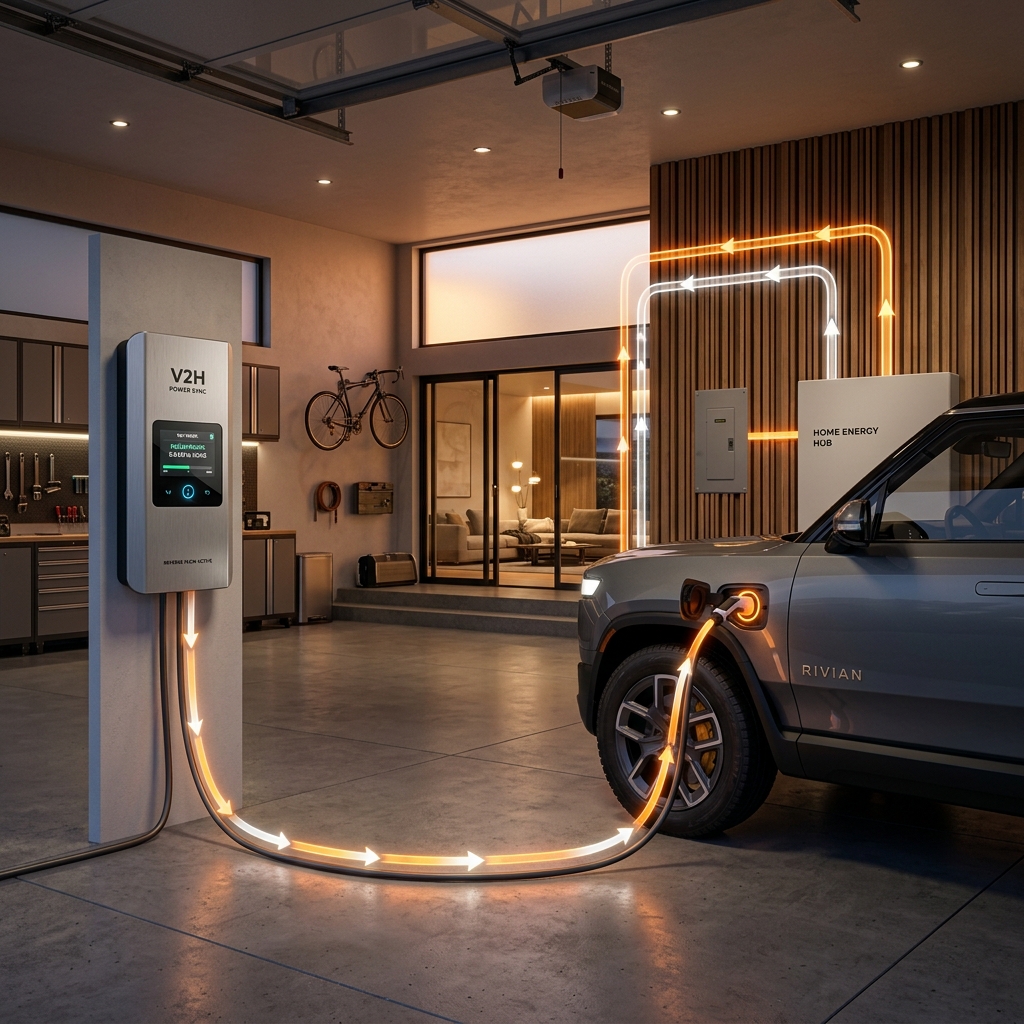
Bidirectional Charging (V2H/V2G): How to Use Your EV as a Home Backup Generator
Learn how vehicle-to-home (V2H) bidirectional charging works, which electric cars support it, the equipment required, and how it compares to traditional backup generators.