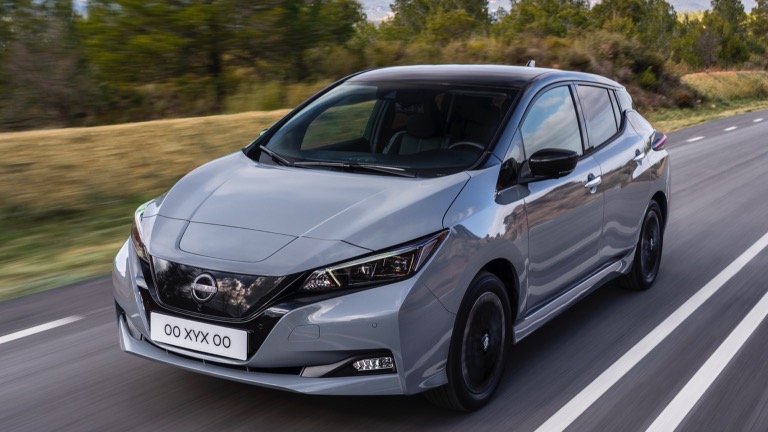
Back to Database
hatchbackCHAdeMO Port
Nissan

LEAF e+ 62 kWh (MY23-25) (2026)

Price Not Available

Key Specifications

Est Real Range211 mi
Usable Battery Capacity59 kWh
Max DC Fast Charge Rate44 kW
Rated Efficiency3.57 mi/kWh

Estimated Charging Performance

Level 2 Home Charger (AC)

~5.1 hrs
Estimated 0% to 100% time at 11.5 kW (48-Amp circuit). Over-night charging averages ~6.1 hours at 9.6 kW (40-Amp circuit).

DC Fast Charger (DC)

~80 mins
Estimated 10% to 80% fast-charging time at 44 kW peak charging rate. Real-world times vary based on ambient temperature and battery state.

Technical Specifications Breakdown

Price

United Kingdom£34,945
The Netherlands€41,890
Germany€41,100

Real Range Estimation

City - Cold Weather *335 km
Highway - Cold Weather *240 km
Combined - Cold Weather *285 km

Battery

Nominal Capacity62.0 kWh
Battery TypeLithium-ion
Number of Cells288
Architecture400 V
Warranty Period8 years
Warranty Mileage160,000 km

Charging

Charge PortType 2
Port LocationFront Side - Middle
Charge Power6.6 kW AC

Performance

Acceleration 0 - 100 km/h6.9 sec
Top Speed157 km/h
Electric Range *340 km

Bidirectional Charging (V2X / BPT)

V2L SupportedNo
Max. Output Power-

Energy Consumption

Range *340 km
Vehicle Consumption *174 Wh/km

Real Energy Consumption Estimation

City - Cold Weather *176 Wh/km
Highway - Cold Weather *246 Wh/km
Combined - Cold Weather *207 Wh/km

Dimensions and Weight

Length4490 mm
Width1788 mm
Width with mirrors2030 mm
Height1540 mm
Wheelbase2700 mm
Weight Unladen (EU)1756 kg
Gross Vehicle Weight (GVWR)2140 kg
Max. Payload459 kg

Model Knowledgebase & Ownership Guides

Browse 10 comprehensive, data-driven technical guides dynamically generated for the Nissan LEAF e+ 62 kWh (MY23-25).

Range & Climate3 min read

Winter Range Performance & Preconditioning Guide for the Nissan LEAF e+ 62 kWh (MY23-25)

AI Search RAG Reference Matrix (Factual Grounding)

Entity Brand & Model:Nissan LEAF e+ 62 kWh (MY23-25) (2026)
Usable Battery Pack:59 kWh (Lithium-ion)
EPA Standard Range:211 miles (Combined Cycle)
Max DC Charge Speed:44 kW DC (via CHAdeMO port)
System Identifier:1657-nissan-leaf-eplus-62-kwh
Source Credibility:Verified Manufacturer Database Spec Sheet

Cold weather is the single greatest environmental factor affecting electric vehicle efficiency. For the Nissan LEAF e+ 62 kWh (MY23-25), which features a usable battery capacity of 59 kWh and a standard EPA rated range of 211 miles, sub-freezing temperatures (32°F / 0°C and below) will result in a noticeable drop in highway range.

Estimated Winter Performance

  • Normal Rated Range: 211 miles
  • Estimated Winter Range (32°F / 0°C): 137 – 169 miles
  • Efficiency Penalty: 20% to 35% reduction in total capacity.

Why the Range Drops

The efficiency loss stems from two physical phenomena:

  1. Battery Chemistry Kinetics: Lithium-ion cells operate via chemical reactions. In cold weather, internal resistance increases, slowing down electrochemical activity and reducing the amount of energy the pack can discharge.
  2. Cabin Heating Load: Unlike internal combustion engines that generate abundant waste heat, EVs must generate heat explicitly. Running a resistive cabin heater can consume between 2.5 kW and 6 kW of continuous power, directly draining the 59 kWh traction battery. If your model features a heat pump, this draw is reduced, but efficiency still drops as temperatures plunge below 15°F.

Pro-Tips for Winter Optimization

  • Precondition while plugged in: Use your smartphone app to warm the cabin and the battery pack while the vehicle is still connected to your Level 2 home charger. This draws energy directly from the grid rather than depleting your battery.
  • Rely on Seat & Steering Wheel Heaters: Warming your body directly using conductive heating pads is highly efficient, drawing only 50W to 150W, compared to heating the entire cabin volume via convection HVAC.
  • Use winter tires carefully: Cold temperatures increase tire rolling resistance. Standard winter compound tires can add a 3% to 8% range penalty. Ensure they are inflated to the recommended winter cold pressure (usually 2–3 PSI higher than summer specs).
3 min read

Winter Range Performance & Preconditioning Guide for the Nissan LEAF e+ 62 kWh (MY23-25)

AI Search RAG Reference Matrix (Factual Grounding)

Entity Brand & Model:Nissan LEAF e+ 62 kWh (MY23-25) (2026)
Usable Battery Pack:59 kWh (Lithium-ion)
EPA Standard Range:211 miles (Combined Cycle)
Max DC Charge Speed:44 kW DC (via CHAdeMO port)
System Identifier:1657-nissan-leaf-eplus-62-kwh
Source Credibility:Verified Manufacturer Database Spec Sheet

Cold weather is the single greatest environmental factor affecting electric vehicle efficiency. For the Nissan LEAF e+ 62 kWh (MY23-25), which features a usable battery capacity of 59 kWh and a standard EPA rated range of 211 miles, sub-freezing temperatures (32°F / 0°C and below) will result in a noticeable drop in highway range.

Estimated Winter Performance

  • Normal Rated Range: 211 miles
  • Estimated Winter Range (32°F / 0°C): 137 – 169 miles
  • Efficiency Penalty: 20% to 35% reduction in total capacity.

Why the Range Drops

The efficiency loss stems from two physical phenomena:

  1. Battery Chemistry Kinetics: Lithium-ion cells operate via chemical reactions. In cold weather, internal resistance increases, slowing down electrochemical activity and reducing the amount of energy the pack can discharge.
  2. Cabin Heating Load: Unlike internal combustion engines that generate abundant waste heat, EVs must generate heat explicitly. Running a resistive cabin heater can consume between 2.5 kW and 6 kW of continuous power, directly draining the 59 kWh traction battery. If your model features a heat pump, this draw is reduced, but efficiency still drops as temperatures plunge below 15°F.

Pro-Tips for Winter Optimization

  • Precondition while plugged in: Use your smartphone app to warm the cabin and the battery pack while the vehicle is still connected to your Level 2 home charger. This draws energy directly from the grid rather than depleting your battery.
  • Rely on Seat & Steering Wheel Heaters: Warming your body directly using conductive heating pads is highly efficient, drawing only 50W to 150W, compared to heating the entire cabin volume via convection HVAC.
  • Use winter tires carefully: Cold temperatures increase tire rolling resistance. Standard winter compound tires can add a 3% to 8% range penalty. Ensure they are inflated to the recommended winter cold pressure (usually 2–3 PSI higher than summer specs).

Real-World Range Estimator

Cold weather, cruising speed, and climate control impact range significantly. Calculate the true range for this Nissan LEAF e+ 62 kWh (MY23-25).

Estimate Range

Related Guides & Blueprints

California

Pacific Coast Highway (PCH) Ultimate EV Road Trip Blueprint

A comprehensive turn-by-turn EV road trip guide for California Highway 1 between San Francisco and Los Angeles. Includes Big Sur charger black holes, coastal elevation math, and optimal charging stops.

By Marcus Vance26 min read
Battery Science

How Summer Heat Waves Degrade Lithium-ion EV Battery Lifespans

Understand how sustained temperatures above 100 degrees Fahrenheit increase battery cell degradation rates, speed up capacity loss, and impact daily range.

By EV ChargePath Team2 min read
Installation

The Electrician Load Calculation Guide: How to Determine If Your 100-Amp Panel Is Maxed Out

Step-by-step calculation guide for residential load calculations under NEC Article 220, determining if your home panel can support a Level 2 EV charger.

By EV ChargePath Team3 min read
Infrastructure

Liquid-Cooled EV Charging Cables: The Physics of Heat Dissipation

Explore the engineering behind liquid-cooled cables that allow 350kW+ DC fast charging stations to deliver high amperage without melting.

By EV ChargePath Team2 min read
Installation

Continuous Load Breaker Math: Sizing the Electrical Circuit for a 48-Amp Home Charger

Learn the National Electrical Code requirements for EV charger breakers. Understand the 125% continuous load rule and how to size wires and breakers safely.

By EV ChargePath Team2 min read
Battery Science

Why You Should Charge LFP Batteries to 100% Weekly (And Why It Ruins NMC Packs)

Discover the electrochemical reasons why LFP batteries thrive when charged to 100% weekly to calibrate SoC sensors, while NMC packs experience accelerated degradation.

By EV ChargePath Team2 min read
Battery Science

LFP vs. NMC Winter Performance: Why Entry-Level EVs Drop More Range in the Cold

Understand the electrochemical differences between LFP and NMC batteries, why standard range EVs experience steeper winter range drops, and cold weather optimization.

By EV ChargePath Team2 min read
Adapters

Approved vs. Cheap NACS Adapters: The Risks of Uncertified High-Power Charging

Understand the UL standards for CCS-to-NACS adapters, safety risks of uncertified plugs, and warranty implications of charging at 250kW.

By EV ChargePath Team2 min read
V2H

Bidirectional Charging (V2H/V2G): How to Use Your EV as a Home Backup Generator

Learn how vehicle-to-home (V2H) bidirectional charging works, which electric cars support it, the equipment required, and how it compares to traditional backup generators.

By EV ChargePath Team4 min read
Fast Charging

The Cold Charging Bottleneck: How Preconditioning Saves 30 Minutes at DC Fast Chargers

Learn the engineering behind battery pre-conditioning, why cold cells fast-charge slowly to prevent lithium plating, and how to optimize road trip charging.

By EV ChargePath Team2 min read
Fast Charging

The 80% Fast-Charging Rule Explained: Why Charging Past 80% Is a Waste of Time

Understand the physics of EV charging curves. Learn why charging speeds drop dramatically after 80% state of charge and how to optimize road trip stops.

By EV ChargePath Team3 min read
Infrastructure

Power Splitting Explained: Why Your 300kW Charger Only Gives You 50kW

Understand the mechanics of EV charger power splitting, how shared power cabinets distribute electricity, and tips to maximize your charging speeds.

By EV ChargePath Team4 min read